All Posts (4078)

Sort by
Raghunandana Thakura

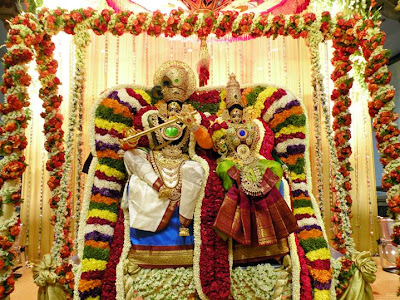
The deity of baby Raghunandana on the lap of his mother at his birthplace, Sri Khanda. Courtesy of Sakhicharan dasa.

    Being called away on medical business, Mukunda Dasa once asked his young son, Raghunandana, to offer the raja bhoga to the family Deity of Gopinatha. Raghunandana prepared everything timely, carefully, and with great devotion. When he made the offering he remembered his father's order, "make sure the Deity eats." Ringing the bell the simple boy told the Gopinatha Deity, "Eat, eat!" Raghunandana began crying when he saw the untouched food remaining on the Deity's plate. He feared his father's anger for his inability to "make the Deity eat." Gopinatha couldn't resist the child's intense devotion. So the Lord ate everything on the plate, leaving no remnants.
 
   Upon returning, Mukunda asked for Gopinatha's Maha-Prasadam. Raghunandana said the Deity ate everything. Astonished, Mukunda told his son to make the offering again. From a hidden place Mukunda watched in total ama
Read more…
Views: 39
Comments: 0
9468730081?profile=originalCourtesy Mother Rasa Manjari;

And then, there is this: "Prabhupada: (...)"Simply rascals. At least expose these rascals. We have no power to kill them, but at least we can expose them. That is also great service.
Hrdayananda: Sometimes, Prabhupada, when we expose them, their argument is, "Oh, you are a saintly person. Why are you criticizing me?"
Prabhupada: No, it is not criticizing. It is opening your eyes. You are blind, you are thinking yourself as very big, so we are opening eyes. You are not big. You are not even pig or fig. That is... ajnana-timirandhasya jnananjana-salakaya. You are blind with ignorance, so we are trying to open your eyes. See things as they are. It is favoring you. It is not criticizing you. [break]...words, vibhu, the great, and anu, the small. So these rascals, they do not understand these two important words, "God is great; I am small." They think, "I am as good as God." This is the folly. [break] ...English proverb? "Where angels dare not, the fools rush
Read more…
Views: 60
Comments: 1

We are violent to the mūḍhas.

Morning Walk — January 21, 1976, Mayapura
Prabhupāda: Still, if you say, “You are mūḍha,” they become angry. Such mūḍhas, rascals, they are in the government service. And if you say that “You are mūḍhas,” he becomes angry. Upadeśo hi mūrkhāṇāṁ prakopāya na śāntaye: “If a mūḍha is advised nice instruction, he becomes angry.” He does not take it. Payaḥ-pānaṁ bhujaṅgānāṁ kevalaṁ viṣa-vardhanam: “If you give milk and banana to a snake, you simply increase his poison.” One day he will come-(growls). You see? “I have given you milk and you…” “Yes, that is my nature. Yes. You give me milk, and I am prepared to kill you.” This is mūḍha. We have to kill this civilization of mūḍhas. That is Kṛṣṇa consciousness movement. Paritrāṇāya sādhūnāṁ vināśāya ca duṣkṛtām [Bg. 4.8]. Those who are actually human being, you have to give them Kṛṣṇa. And those who are mūḍhas, we have to kill them. This is our business. Kill all the mūḍhas and give Kṛṣṇa to the sane man. Yes. That will prove that you are really
Read more…
Views: 25
Comments: 0

"Yes, anyway, follow the instruction. That is required. Follow the instruction. Wherever you remain, it doesn't matter. You are secure. Follow the instruction. Then you are secure anywhere. It doesn't matter. Just like I told you that I saw my Guru Maharaja not more than ten days in my life, but I followed his instruction. I was a gṛhastha, I never lived with the Maṭha, in the temple. It is practical."

Read more…
Views: 26
Comments: 2

9468781882?profile=originalIn the Brahma-vaivarta Purana, mother Ganges petitions Lord Krishna: “O protector, supreme enjoyer, after Your departure for the supreme abode, Goloka, what will be my condition in the degraded age of Kali?”

The Supreme Personality of Godhead said: “On the earth 5,000 years of Kali will be very sinful and sinners will come and deposit their sins in you by bathing.

"Thereafter simply by the sight or touch of One who will worship Me by My Mantras*, all those sins will be burnt at once.

(*Here Lord Krishna is indicating His own concealed incarnation in the form of Lord Gauranga in Kali-yuga when He will appear as His own upasaka or worshiper for the purpose of teaching devotional service to everyone by the chanting of His Holy Names of Nityananda and Gauranga and the Hare Krishna maha-mantra. The Lord will appear in Navadvipa on the bank of the Ganga and destroy all the sins accumulated in the Ganga by taking bath and sporting in Her waters with His eternal associates for 24 years.)

“Ever

Read more…
Views: 79
Comments: 0

Srila Prabhupada and the Ants...

9468777287?profile=originalPrabhupada and the Ants...

"When Srila Prabhupada took his lunch it immediately became known by the resident ant population. They always had scouts running along the walls and within minutes of putting his plate on the table, they would call in the battalions. Once, in Los Angeles Srila Prabhupada told me to put some turmeric down at the spots they were entering. It worked in Los Angeles. I suppose those ants were more materialistic. The ants in Mayapur could not be stopped. Obviously, they were spiritual entities and they could not be discouraged from taking maha prasadam remnants from the plate of the pure devotee.

I watched as hundreds of ants ascended up the leg of the choki, circling his plate to finally descend upon his prasadam. They seemed to know exactly when they were allowed on a certain preparation. Srila Prabhupada would eat in stages. First there were the vegetables and chapatis, the rice was mixed in later on and then finally the sweets were eaten. Initially they would

Read more…
Views: 80
Comments: 2

My Guru Mahārāja used to say that "This material world is not fit for living for any gentleman." He used to say. "No gentleman can live here." So these things are not understood by the nondevotees, how much pinching this material world is.

So unless one becomes detestful of this material world, it is to be understood that he has not yet entered in the spiritual understanding. Bhaktiḥ pareśānubhavo viraktir anyatra syāt [SB 11.2.42]. This is the test of bhakti. If one has entered the domain of devotional service, this material world will be not at all tasteful for him.

Srila Prabhupada - Śrīmad-Bhāgavatam 7.9.15 —
Māyāpur, February 22, 1976

Read more…
Views: 58
Comments: 2

Surrender to Krishna Means...

9468778073?profile=originalWoman: Srila Prabhupada, what does it mean practically to surrender unto Krsna?

Prabhupada: Yes. Surrender to Krsna means you have to accept things which is favorable for Krsna consciousness. Just like we restrict our students, no illicit sex, no gambling, no meat-eating, no intoxication. If you surrender to this process, that is surrender to Krsna. Is it clear? If you don't surrender, there is no surrender. Then you are not surrendered soul. Chant sixteen rounds, and if you follow, that is surrendering to Krsna. Don't take anything except krsna-prasadam. That is surrendering to Krsna. So many we have got. So if you surrender to these principles, that means you surrender to Krsna. Just like a good citizen surrenders to the state. What does it mean? He abides by the law. That's all. He does not do anything which is against the will of the state. That's all. So you surrender to the principles; then you surrender to Krsna. That's all.
(BG 7.1-3, London, August 4, 1971)

Read more…
Views: 28
Comments: 0

Satyam,truthfulness

Padmagarbha Das From Srila Prabhupada's BG 10.4 purport:

"Satyam,truthfulness, means that facts should be presented as they are for the benefit of others. Facts should not be misrepresented. According to social conventions, it is said that one can speak the truth only when it is palatable to others. But that is not truthfulness. The truth should be spoken in a straight and forward way, so that others will understand actually what the facts are. If a man is a thief and if people are warned that he is a thief, that is truth. Although sometimes the truth is unpalatable, one should not refrain from speaking it. Truthfulness demands that the facts be presented as they are for the benefit of others. That is the definition of truth."

Read more…
Views: 38
Comments: 0
"Crazy Fellows and Colorful Life"

Srimad-Bhagavatam 3.26.05
Bombay, December 17, 1974

download  Players

Srila A. C. Bhaktivedanta Swami Prabhupada


Nitai: "Divided into varieties by her threefold modes, material nature creates the forms of the living entities, and the living entities, seeing this, are illusioned by the knowledge-covering feature of the illusory energy."

Prabhupada:

gunair vicitrah srjatim
sa-rupah prakrtim prajah
vilokya mumuhe sadyah
sa iha jnana-guhaya
 [SB 3.26.5]

Living entities, they have knowledge. That is the difference between matter and living entities. Living entities, they have got knowledge. The dull matter still requires to be developed. They are also covered knowledge. There is knowledge, but it is covered. Just like the tree: it is also a living entity, but the knowledge is more covered than the moving living entities. There are two kinds of living entities: moving and not moving, sthavara-jangama. Sthavara means standing, cannot move. And jangama means moving. So jangama is better than this sthava
Read more…
Views: 28
Comments: 1

9468777274?profile=original

Srila Prabhupada kindly explains;

You can take the iron rod which is red hot in association with fire and touch anything; it will burn. That means it is no longer acting as iron; it is acting as fire. Similarly, if you associate with this transcendental incarnation, sound incarnation of God, then you will be gradually godly.

Prabhupada: Now, some of you members have asked me to explain the meaning of this chanting, Hare Krishna, Hare Krsna, Krsna Krsna, Hare Hare. Hare Rama, Hare Rama, Rama Rama, Hare Hare. Now, this sound is transcendental sound, transcendental sound, incarnation, sound incarnation of the Absolute Truth. Just try to understand what is incarnation. Incarnation means… The Sanskrit word is avatara, and that is translated into English as “incarnation.” Of course, the root meaning of incarnation I cannot exactly explain to you, but the root meaning of the… (aside:) Somebody stop. Yes. The root meaning of avatara is “which comes from the transcendental sky, the spiritu

Read more…
Views: 17
Comments: 0
9468776299?profile=original
Read more…

Vedic Afghanistan ; Some history


Hindu history of Afghanistan Afghanistan" comes from "Upa-Gana-stan" Raja Jaya Pal Shahi, Ruler of Punjab bore the brunt of the Islamic Onslaught. The year 980C.E. marks the beginning of the Muslim invasion into India proper when Sabuktagin attacked Raja Jaya Pal in Afghanistan. Afghanistan is today a Muslim country separated from India by another Muslim country Pakistan. But in 980 C.E. Afghanistan was also a place where the people were Hindus and Buddhists. The name "Afghanistan" comes from "Upa-Gana-stan" which means in Sanskrit "The place inhabited by allied tribes". This was the place from where Gandhari of the Mahabharat came from Gandhar whose king was Shakuni. The Pakthoons are descendants of the Paktha tribe mentioned in Vedic literature. Till the year 980 C.E., this area was a Hindu majority area, till Sabuktagin from Ghazni invaded it and displaced the ruling Hindu king - Jaya Pal Shahi. The place where Kabul's main mosque stands today was the site of an ancient Hindu temple and the story of its capture is kept alive in Islamic Afghan legend which describes the Islamic hero Sabuktagin who fought with a sword in every hand to defeat the Hindus and destroy their temple to put up a Mosque in its place. The victory of Sabuktagin pushed the frontiers of the Hindu kingdom of the Shahis from Kabul to behind the Hindu Kush mountains Hindu Kush is literally "killer of Hindus" - a name given by Mahmud Ghazni to describe the number of Hindus who died on their way into Afghanistan to a life of captivity . After this setback, the Shahis shifted their capital from Kubha (Kabul) to Udbhandapura (modern Und in NWFP). Sabuktagin's son Mahmud Ghazni, kept up the attacks on the Shahis and captured Und. Subsequently, the Shahis moved their capital to Lahore and later to Kangra in Himachal. *** The recovery and significance of the inscription, telling a story of the Hindu ruler Veka and his devotion to lord `Siva', was told by leading epigraphist and archaeologist Prof Ahmad Hasan Dani of the Quaid-E-Azam University of Islamabad at the ongoing Indian History Congress here. If historians, preferred to revise the date of the first Hindu Shahi ruler Kallar from 843-850 AD to 821-828 AD, the date of 138 of present inscription, if it refers to the same era, should be equal to 959 AD which falls during the reign of Bhimapala'', Dani said in a paper `Mazar-i Sharif inscription of the time of the Shahi ruler Veka, dated the year 138'', submitted to the Congress. The inscription, with eleven lines written in `western Sarada' style of Sanskrit of 10th century AD, had several spelling mistakes. ``As the stone is slightly broken at the top left corner, the first letter `OM' is missing'', he said. According to the inscription, "the ruler Veka occupied by eight-fold forces, the earth, the markets and the forts. It is during his reign that a temple of Siva in the embrace with Uma was built at Maityasya by Parimaha (great) Maitya for the benefit of himself and his son''. Dani said ``the inscription gives the name of the king as Shahi Veka Raja and bestows on him the qualification of `Iryatumatu Ksanginanka'.... and (he) appears to be the same king who bears the name of Khingila or Khinkhila who should be accepted as a Shahi ruler''. Dani further said ``he may be an ancestor of Veka deva. As his coins are found in Afghanistan and he is mentioned by the Arab ruler Yaqubi, he may be an immediate predecessor of Veka deva...... Both the evidences of inscription and coins suggest that Veka or Vaka should be accepted as an independent ruler of northern Afghanistan. "Thus we find another branch of the Shahi ruler in northern part of Afghanistan beyond the Hindukush. Veka is said to have conquered the earth, the markets and the forts by his eight-fold forces, suggesting that he must have himself gained success against the Arab rulers of southern Afghanistan''. Dani observed that going by the findings it seemed that during the rule of the Hindu Shahi ruler Bhimapala there was a break in the dynasty -- one branch, headed by Jayapala, ruled in Lamaghan and Punjab, and another branch, headed by Veka, ruled in northern part of Afghanistan. "The northern branch must have come to an end by the conquest of Alptigin in the second half of tenth century AD'', he said. (source: Inscription throws new light to Hindu rule in Afghanistan - indianexpress.com) India has developed a highly constructive, imaginative reconstruction strategy for Afghanistan that is designed to please every sector of Afghan society, give India a high profile with the Afghan people, gain the maximum political advantage with the Afghan government, increase its influence with its Northern Alliance friends and turn its image from that of a country that supported the Soviet invasion and the communist regime in the 1980s to an indispensable ally and friend of the Afghan people in the new century. (Source: Hinduism (The forgotten facts)')

Hindu history of Afghanistan

Afghanistan" comes from "Upa-Gana-stan" Raja Jaya Pal Shahi, Ruler of Punjab bore the brunt of the Islamic Onslaught.

The year 980C.E. marks the beginning of the Muslim invasion into India proper when Sabuktagin attacked Raja Jaya Pal in Afghanistan. Afghanistan is today a Muslim country separated from India by another Muslim country Pakistan. But in 980 C.E. Afghanistan was also a place where the people were Hindus and Buddhists.

The name "Afghanistan" comes from "Upa-Gana-stan" which means in Sanskrit "The place inhabited by allied tribes".

This was the place from where Gandhari of the Mahabharat came from Gandhar whose king was Shakuni. The Pakthoons are descendants of the Paktha tribe mentioned in Vedic literature. Till the year 980 C.E., this area was a Hindu majority area, till Sabuktagin from Ghazni invaded it and displaced the ruling Hindu king - Jaya Pal Shahi.

The place where Kabul's main mosque stands today was the site of an ancient Hindu

Read more…
Views: 66
Comments: 0
9468771296?profile=original
The śāstras of the yavanas, or meat-eaters, are not eternal scriptures. They have been fashioned recently, and sometimes they contradict one another. The scriptures of the yavanas are three: the Old Testament, the New Testament and the Koran. Their compilation has a history; they are not eternal like the Vedic knowledge. Therefore although they have their arguments and reasonings, they are not very sound and transcendental. As such, modern people advanced in science and philosophy deem these scriptures unacceptable.

Srila Prabhupada
Śrī Caitanya Caritāmṛta, Ādi-līlā, Chapter 17.169, Purport
Read more…
Views: 20
Comments: 0
Carolann Kāmā Gāyātrī Martinez's photo.

4,000 Year Old Vishnu Statue Discovered in Vietnam

A recent news report from Vietnam features an exquisite and very ancient sculpture of Lord Vishnu. According to a press release from the Communist Party of Vietnam’s Central Committee (CPVCC) the Vishnu sculpture is described as “Vishnu stone head from Oc Eo culture, dated back 4,000- 3,500 years.” Recently the Government of Vietnam, despite its official Communist doctrine, has developed many programs and projects highlighting Vietnam’s ancient religious heritage. Its scholarly and archeological research and investigations are legitimate and its conclusions are authoritative. This discovery of a 4,000 to 3,500 year old Vishnu sculpture is truly historic and it sheds new light upon our understanding of the history of not only Hinduism but of the entire world.

The fact is there are no other ‘officially’ recognized Vedic artifacts that have been dated back to such an early date. This would make Vietnam home to

Read more…
Views: 101
Comments: 0
Sri Krishna manifests His eternal birth, the pure cognitive essence of the serving soul who is located above all mundane limitations. King Kamsa [the demon king who wanted to kill Lord Krishna] is the typical empiricist, ever on the lookout for the appearance of the truth for the purpose of suppressing Him before He has time to develop. This is no exaggeration of the real connotation of the consistent empiric position. The materialist has a natural repugnance for the transcendent. He is disposed to link that faith in the incomprehensible is the parent of dogmatism and hypocrisy in the guise of religion. He is also equally under the delusion that there is no real dividing line between the material and the spiritual. He is strengthened in his delusion by the interpretation of scriptures by persons who are like-minded with himself. This includes all the lexicographic interpreters.
The lexicographical interpretation is upheld by Kamsa as the real scientific explanation of the scriptures,
Read more…
Views: 33
Comments: 0

Bhaktivedanta_Swami_with_Jagannath_in_Golden_Gate_Park,_February_1967.jpg

The International Society for Krishna Consciousness has potential as a peaceful extra-governmental force for this kind of change, nationally and internationally. In 1966, Srila Prabhupada included in ISKCON’s articles of incorporation a far-reaching statement of the movement’s purposes. Among them: “To bring the members closer together for the purpose of teaching a simpler, more natural way of life.”
Srila Prabhupada did not, however, recommend high-pressure lobbying. Instead, he emphasized the establishment of self-sufficient agrarian communities. “If these farm projects are successful,” he wrote to a disciple in 1975, “then all this industry will be closed. We do not have to make propaganda, but automatically people will not want [it].” Srila Prabhupada also envisioned gardenlike towns that would be more habitable than today’s cities and suburbs.
People want a secure and satisfying way of life. If they can be shown attractive alternatives to life in industrial society, they will make t

Read more…
Views: 41
Comments: 0

Lokanatha Goswami

His body and mind were completely attached to Vrindavanadhama. The divine Was of Radha-Vinoda played in his heart. His ears existed only to hear the Shrimad Bhagavatam. "Anyone who reads the Shrimad Bhagavatam," said Lokanatha Goswami, "he is my friend." (In the images: Shrila Lokanatha Goswami).

   A personal associate of Lord Gauranga, fully absorbed in pure love, Shri Lokanatha Goswami was the eldest of the Goswamis living in Vraja-bhumi. He shunned name and fame so much that he asked Krishna Dasa Kaviraja to keep his name out of Chaitanya-charitamrta.
 
   His body and mind were completely attached to Vrindavanadhama. The divine Was of Radha-Vinoda played in his heart. His ears existed only to hear the Shrimad Bhagavatam. "Anyone who reads the Shrimad Bhagavatam," said Lokanatha Goswami, "he is my friend."
    .
   Once Shri Krishna Himself appeared and gave Lokanatha a Deity of Radha-Vinoda. Lokanatha Goswami carried his Deity all over Vraja in a cloth bag hung around his neck.
 
   Alth

Read more…
Views: 24
Comments: 0