All Posts (4100)

Sort by

Revati-Balarama

.
.
.
 Lila how REVATI king Kakudmi's daughter met and married BALARAMA -------
Revati, within Hinduism, is the daughter of King Kakudmi and the wife of Balarama, the elder brother of Krishna. Her account is given within a number of Puranic texts such as the Mahābhārata and 9468761866?profile=originalBhagavata Purana.
Meeting with Brahma

Revati was the only daughter of King Kakudmi (sometimes called Kakudmin, or Raivata), a powerful monarch who ruled Kusasthali, a prosperous and advanced kingdom under the sea, and who also controlled large tracts of land, including Anarta kingdom. Feeling that no human could prove to be good enough to marry his lovely and talented daughter, King Kakudmi took Revati with him to Brahma-loka (the plane of existence where Lord Brahma, the Creator, resides) to ask Lord Brahma's advice about finding a suitable husband for Revati.

When they arrived, Lord Brahma was listening to a musical performance by the Gandharvas, so they waited patiently until the performance was finished. The
Read more…
Views: 141
Comments: 0

Hayagriva Jayanthi

602065_558473304200128_1501609453_n.jpg
Jna:na:nanda mayam de:vam nirmala sphatika:kritham 
a:dha:ram sarva vidya:na:m hayagri:vam upa:smahe

Oh! Lord Hayagriva. You are the treasure and supporter of all knowledge. You are the personified knowledge and joy. You shine like a clear crystal without any blemish. Your Divine Grace makes us knowledgeable. I meditate upon you Oh! Lord Hayagriva, The abode of all knowledge. (From Vedanta Desika's Hayagrivam Stotram)
Read more…
Views: 26
Comments: 0

9468758286?profile=original

Hare Krsna. All glories to His Divine Grace, Srila Prabhupada. All glories to Lord Balaram, Who is the source of all spiritual strength.

Please accept my fallen obeisances.

From Srila Prabhupada's CC 1.1.168 purport: "There is no difference between the bodily forms of Sri Krsna and Balarama except that Their bodily colors are different - the bodily hue of Krsna is dark and that of Balarama is fair."

From Srila Prabhupada's "Krsna Book" ("Prayers by the Demigods"): "In the Upanisads it is stated that one cannot attain the supreme or any form of self-realization without being sufficiently favored by Balarama...One must have the spiritual strength which is infused by Balarama or Sankarsana...The spiritual master is the representative of Balarama, the Supreme Personality of Godhead, who supplies spiritual strength."

Lord Balaram exhibits softness and love for His devotees: (From Srila Prabhupada's "Krsna Book," "Lord Balaram Visits Vrndavan") "When the gopis arrived, Lord Balarama glance

Read more…
Views: 33
Comments: 0

Sri Balabhadra-stotra-kavaca

Jahnava-Mata-3.jpg

Garga-samhita 


duryodhana uvaca
gopibhyam kavacam dattam
gargacaryena dhimata
sarva-raksha-karam divyam
dehi mahyam maha-mune

Duryodhana said: O great sage, please give me the transcendental Balarama-kavacha, which wise Garga Muni gave to the gopis, and which gives all protection. 


shri-pradvipaka uvaca
snatva jale kshauma-dharah kushasanah
pavitra-paniu krita-mantra-marjanah
smritvatha natva balam acyutagrajam
sandharayed dharma-samahito bhavet

Shri Pradvipaka Muni said: After bathing and dressing in clean cotton garments, a person should sit on a kusha-grass mat, purify his hands with mantras, bow down, and with fixed intelligence meditate on Lord Krishna's elder brother, Lord Balarama.


goloka-dhamadhipatih pareshvarah
pareshu mam patu pavitra-kirtanahbhu-mandalam sarshapavad vilakshyate
yan-murdhni mam patu sa bhumi-mandale

May Lord Balarama, who is the master of Goloka, who is the supreme controller of all controllers, and whose fame is spotless, protect me. May Lord Balarama, who on His head hold

Read more…
Views: 84
Comments: 1

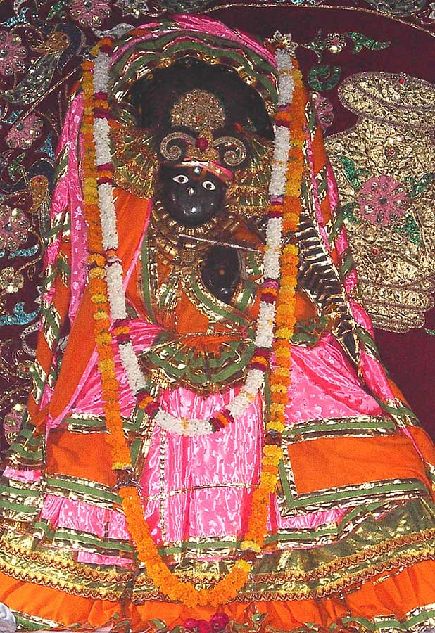
Dauji (Balarama)

Dauji is one of the four presiding Deities of Vraja. All the famous Deities left Vraja, but Dauji did not leave even after He revealed Himself to the Muslims.


1251366510.jpeg
24 kilometers from Mathura there is a village called BaldeoorDauji. Originally it was called Ridha. It is a home of Balaram Deity.
Dauji means the "older brother" and it is the name of Balaram.
Deity of Dauji is about 2 meters high and it is the largest Deity in Vraja-mandala. This Balaram Deity was installed by Vajranabha 4900 years ago.
Extremely attractive sri-vigraha of Balaram is syama-complexioned (blackish), with huge eyes, and His right hand is raised. In His left hand is a cup of Varuni beverage.
Revati, the wife of Balaram, is also installed in this temple. She is to the left of the front altar door with Her back to the wall facing Balaram. She cannot be seen from the front door of the altar, but She can be viewed from the right side door...
...The confidential reason why she is somewhat concealed is that Sri Dauji's marriage
Read more…
Views: 307
Comments: 0

Balabhadra Stava Raja

1251366510.jpeg Dauji (Balaram)

From the Garga Samhita translation of Kushakratha Dasa Prabhu.

Chapter Eleven

Shri Balabhadra-stava-raaja
The King of Prayers to Lord Balaraama

Text 1

duryodhana uvaaca

stotram shri-baladevasya
praadvipaaka mahaa-mune
vada maam kripayaa saakshaat
sarva-siddhi-pradaayakam

duryodhana uvaaca-Duryodhana said; stotram-prayer; shri-baladevasya'of Lord Balaraama; praadvipaaka-Shri Praadvipaaka Muni; mahaa-mune-O great sages; vada-please tell; maam-me; kripayaa-mercifully; saakshaat'directly; sarva-siddhi-pradaayakam-giving all perfection.

Duryodhana said: O Praadvipaaka, O great sage, please kindly tell me the prayer of Lord Balaraama, which grants all perfection.

Text 2

shri-praadvipaaka uvaaca

stava-raajam tu raamasya
vedavyaasa-kritam shubham
sarva-siddhi-pradam raajan
chrinu kaivalyadam nrinaam

shri-praadvipaaka uvaaca-Shri Praadvipaaka Muni said; stava-of prayers; raajam-the king; tu-indeed; raamasya-of Lord Balaraama; vedavyaasa-kritam-written by Vedavyaasa; s

Read more…
Views: 79
Comments: 0

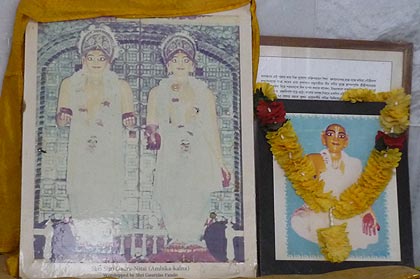
Srila Gauridasa Pandita Disappearance

picture-12.jpg

Gauridas Pandit (four Gaura-Nitai Deities, Gaura Purnima celebration)

--------------- Across the Ganges from Santipur, in a small town called Ambika Kalna, which is within the present district of Barddhama, is where Gauri dasa Pandita's temple is located.
His worshippable Deities Sri Sri Gaura-Nityananda are still residing in all their splendor there.
There is a railway station at Ambika Kalna on the Howrah-Navadvipa line.
From there one can proceed by rickshaw to Mahaprabhu Mandira.
In the temple is an old copy of the Bhagavad-gita on palm leaves which is supposed to have been written by the hand of Mahaprabhu Himself.
There is also an oar from a boat which has an interesting story behind it.

One day, the two Lords Caitanya and Nityananda came to Kalna from Santipur by boat, paddling it themselves.
Lord Caitanya kept the oar in His hand, and when He entered Gauri dasa's house He gave it to him, saying, "With this you should cross over the ocean of material existence, taking all the

Read more…
Views: 38
Comments: 0

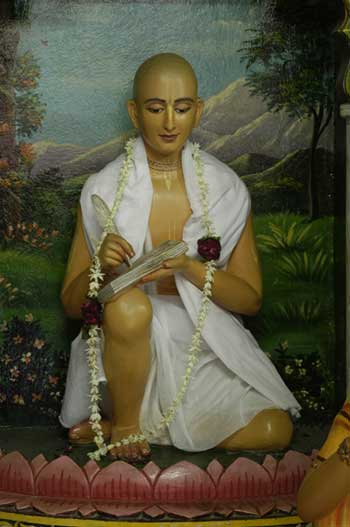
Srila Rupa Gosvami Disappearance

rupa+goswami.jpg

In the conclusion of his Laghutosani Jiva Gosvami has given some biographical information in which he explains that Sarvajna is seventh in the ascending genealogical line from Rupa Gosvami.
He was highly respected amongst the brahmanas of Karnataka, thus he was also referred to as "Jagadguru."
Being a brahmana from the Yajurveda clan, who are descendants of Bharadvaja, Sarvajna was a erudite scholar of all sastras and theological treatises.
Attracted by Sarvajna's scholastic ability and admirable qualities, students flocked from different parts of the country tostudy under him.
Sarvajna was also a king.
Sarvajna's son, Aniruddha, was a great Yajurveda scholar and was admired by all.
Aniruddha had two wives and two sons.
His sons were Rupesvara and Harihara.
Rupesvara became theologically astute, whereas Harihara became skilled in the use of weapons.

When Aniruddha died the kingdom was divided between the two sons, but Harihara occupied the land of Rupesvara by force.
In a helpless condition Rupe

Read more…
Views: 44
Comments: 0
2 Excellent Quotes, courtesy Prabhu Likith Kumar.

"Confidential devotees of the Lord see in every step a benedictory direction of the Lord. What is considered to be an odd or difficult moment in the mundane sense is accepted as special mercy of the Lord. Mundane prosperity is a kind of material fever, and by the grace of the Lord the temperature of this material fever is gradually diminished, and spiritual health is obtained step by step. Mundane people misunderstand it. "Srimad-Bhagavatam 1.6.10

" No one can understand the import of the Vedas without having undergone a strict disciplinary vow and disciplic succession. The Vedas, spiritual masters and sacrificial fire must be worshiped by the desiring candidate. All these intricacies of Vedic knowledge are systematically presented in the Mahabharata for the understanding of the woman class, the laborer class and the unqualified members of brahmana, ksatriya or vaisya families. In this age, the Mahabharata is more essential than the o
Read more…
Views: 33
Comments: 0

Pavitropana Ekadasi

Pavitropana Ekadasi

BY: SUN STAFF

Aug 15, 2013 — INDIA (SUN) — Pavitropana or Putrada Ekadasi, observed on August 17th, from the Bhavishya Purana.

Shri Yudhisthira Maharaja said, "Oh Madhusudana, Oh killer of the Madhu demon, please be merciful to me and describe to me the Ekadasi that occurs during the light fortnight of the month of Shravana (July-August)." The Supreme Lord, Sri Krishna, replied, "Yes, Oh king, I shall happily narrate its glories to you, for just by hearing about this sacred Ekadasi one attains the merit of performing a horse sacrifice.

"At the dawn of Dvarpara-yuga there lived a king by the name of Mahijita, who ruled the kingdom of Mahismati-puri. Because he had no son, his entire kingdom seemed utterly cheerless to him. A married man who has no son gains no happiness in this life or the next.

The Sanskrit word for 'son' is putra. Pu is the name of a particular hell, and tra means 'to deliver.' Thus the word putra means 'a person who delivers one from the hell na

Read more…
Views: 24
Comments: 0

Ashtabhuyakaram (Adi-keshava Perumaal)

Deities: The Moolavar here is Adikesava Perumaal also known as Gajendravaradan or Chakradharar, in a standing posture facing west. Taayaar here is Alarmelmangai or Padmasini. The image of Adikesava Perumaal has 8 arms, with 8 weapons (the discus, sword, a flower, an arrow, the conch, a bow, a shield and a mace). The Utsavar has 4 arms bearing a mace and a spear.

Legends: This temple is associated with the legend of Gajendra Moksham, where it is believed that a devout elephant Gajendran, who was in the habit of making an offering of lotus flowers from the Ashtabhuja temple tank, to Vishnu was caught by the grip of a crocodile. The pleas of the elephant were answered by Vishnu who vanquished the crocodile with his disc.

This temple covers an area of about an acre. Bhramotsavam is celebrated in the month of Chittirai, and Gajendramoksham in Aadi.


Tirukkachchi or Attigiri (Varadaraja Perumaal)

Description: Varadaraja Perumaal temple, one of the celebrate

Read more…
Views: 211
Comments: 16

Srila Tulsi Das Goswami

993977_648386021840791_647741864_n.jpg

Tulsidas Life History:
Tulsidas was a great devotee of Lord Rama and Hanuman. He was a composer of Ramcharitmanas, and great devotee of Lord Rama. It is believed that one has to take several births to attain this honor which Tulsidas was able to attain in his life. He was respected and worshipped by his followers and disciples. He was born in 1589 in Rajapur (Chitrakuta), a village on the banks of the Yamuna river in Uttar Pradesh. His parents were Hulsi and Atmaram Dubey.

Tulsidas was an unfortunate child and has go through various problems and sufferings during his childhood days. Later he was married to Ratnavali. He immensely loved his wife, and due to this one day he had to listen to harsh words uttered by his wife remarking, “ that if Tulsidas was even half as devoted to God as he was to her body of flesh and blood, he would have been redeemed from his suffering”. Tulsidas left her instantly and decided to devote his life in the worshipping of Lord Rama. He also gained wisdom from

Read more…
Views: 109
Comments: 1

9468766870?profile=originalLikith Kumar Spiritual feelings of happiness and intense ecstasies have no mundane comparison. Therefore it is very difficult to give expression to such feelings. We can just have a glimpse of such ecstasy in the words of Sri Narada Muni. Each and every part of the body or sense has its particular function. After seeing the Lord, all the senses become fully awakened to render service unto the Lord because in the liberated state the senses are fully efficient in serving the Lord. As such, in that transcendental ecstasy it so happened that the senses became seperately enlivened to serve the Lord. This being so, Narada Muni lost himself in seeing both himself and the Lord simultaneously. Srimad-Bhagavatam 1.6.17

Read more…
Views: 49
Comments: 1
Spiritual not Material Body - The Third Miracle

BY: BHAGAVAT DAS (ACBSP)

The following pastimes demonstrate how a pure devotee is simultaneously present in this materiel world and yet totally disconnected from it and therefore not under its jurisdiction.

When Srila Prabhupada had his heart operation in the US many years ago the doctors put him under anesthesia as usual. However Srila Prabhupada remained conscious and chanted the holy name of Krishna throughout the procedure. The doctors of course were astounded, as any one would be who knows the powerful effects of anesthesia. It completely shuts down your brain and nervous system so that you feel and remember nothing. The subtle body consisting of mind, intelligence, and false ego, would not be able to perceive anything since the physical mechanism for expressing the subtle body, the brain, and nervous system would be shut down. For someone to remain conscious through such a procedure they would have to be completely transcendental to

Read more…
Views: 26
Comments: 0

Srila-Raghunandana-Thakura.jpg

CC Ādi 10.78-79

khaṇḍavāsī mukunda-dāsa, śrī-raghunandana
narahari-dāsa, cirañjīva, sulocana
ei saba mahāśākhā — caitanya-kṛpādhāma
prema-phala-phula kare yāhāṅ tāhāṅ dāna
Word for word: 
khaṇḍa-vāsī mukunda-dāsa — Mukunda dāsa, a resident of Śrīkhaṇḍa; śrī-raghunandana — Raghunandana; narahari-dāsa — Narahari dāsa; cirañjīva — Cirañjīva; sulocana — Sulocana; ei saba — all of them; mahā-śākhā — great branches; caitanya-kṛpā-dhāma — of Lord Śrī Caitanya Mahāprabhu, the reservoir of mercy; prema — love of God; phala — fruit; phula — flower; kare — does; yāhāṅ — anywhere; tāhāṅ — everywhere; dāna — distribution.
Translation: 
Śrī Khaṇḍavāsī Mukunda and his son Raghunandana were the thirty-ninth branch of the tree, Narahari was the fortieth, Cirañjīva the forty-first and Sulocana the forty-second. They were all big branches of the all-merciful tree of Caitanya Mahāprabhu. They distributed the fruits and flowers of love of Godhead anywhere and everywhere.
Purport: 

Śrī Mukunda dāsa was the son of Nār

Read more…
Views: 21
Comments: 0

Vamsidasa babaji Disappearance

971051_619868034712807_984569674_n.jpg
'During the time of Srila Prabhupada Bhaktisiddhanta Sarasvati Gosvami Thakura there was a very prominent babaji named Vamsidasa babaji. He had long hair and wore only one loincloth nothing else. He had no bhajana-kutira at all. Rather, he lived under the shade of a tree as did his two deities, Gaura and Nityananda, who were always undecorated. Vamsidasa babaji used to play with them and sometimes quarrel with Them. He once went to pick some flowers for his worship, and there was a tree nearby with yellow karnikara flowers. It was not a very high tree, so he climbed up that tree to pick flowers. In the meantime the son of the proprietor of that land came and said, "What nonsense are you doing? He pushed Vamsidasa babaji, who fell down from the tree and became somewhat injured. Vamsidasa babaji then went directly to his deities and began to quarrel. He said, "Oh, Nityananda is very simple and very good. But this Mahaprabhu is very tricky and very cruel! I was picking some flowers for H

Read more…
Views: 30
Comments: 0

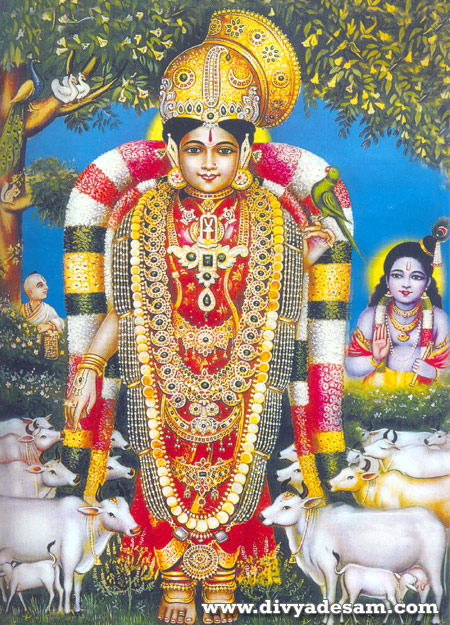
Sri Andal Amma appearance

sri-andal-2b.jpg

Andal, the incarnation of Mother Earth, Bhoodevi, is one of the twelve Aalvaars, great devotees of Vishnu. She was found in the garden of Periyaalvar. She grew up to be a great devotee of Vishnu and a mystic poet. She is the author of Thiruppavai. Even as a human she attained beatitude, as the consort of her chosen Lord Ranganatha of Srirangam. She is the best exponent of Bakthi Marga and a celebrated model of "bridal mysticism".

SLOKA/PRAYER

Sree Vishnu Chiththa Kula Nandhana Kalpa Valleem
Sree Ranga Raaja Hari Chandhana Yoga Dhrusyaam
Saakshhat Kshammaam Kaarunyaa Kamalaami Vaanyaam 
Godhaam Ananya Sarana: Saranam Prapadhye.

MEANING

Bereft of any other refuge in Godha (Andal) who is merciful like Goddess Mahalakshmi, has come in human form of Andal. She is like a wish fulfilling creeper, that makes the family of Vishnuchitta (Periyaalvar) happy. With her inner eye, she always sees and dwells on her Lord, the king and God at Sriranga.

Source:http://www.ssvt.org/deities/aandal.asp

Read more…
Views: 318
Comments: 0

9468758858?profile=original

The prime difference between the Lord and the living entities is that the Lord is the creator and the living entities are the created. Here He is called the amogha-lilah, which indicates that there is nothing lamentable in His creation. Those who create disturbance in His creation are themselves disturbed. He is transcendental to all material afflictions because He is full with all six opulences, namely wealth, power, fame, beauty, knowledge and renunciation, and thus He is the master of the senses. He creates these manifested universes in order to reclaim the living beings who are within them suffering threefold miseries, maintains them, and in due course annihilates them without being the least affected by such actions. He is connected with this material creation very superficially, as one smells odor without being connected with the odorous article. Nongodly elements, therefore, can never approach Him, despite all endeavors.

Srimad-Bhagavatam 1.3.36

Read more…
Views: 18
Comments: 1