All Posts (4075)

Sort by

Is Your page infested with pada-ites?

Is Your page is infested with pada-ites? Speak truth and chant hare krsna, they will flee, no problem.

Ex; 1 no need for a Guru ever again anymore ending the sampradaya, 2 or they want a new succession of Ritvik Acaryas, or 3 every other pure devotee is not a pure devotee ever only S Prabhupada, or 4 sit and chant and let krsna take care of it, or 5 SNM, or 6 compromise and cooperate or 7 forgive the killers or 8 Hansadutta is the only ritvik, or 9 i cant do ritivk im not authorized i have nothing etc - deviant ideas fed to them by cia /nwo/maya agents.

Image may contain: 3 people, sky
Image may contain: 1 person, standing
Image may contain: one or more people, people standing, sky and outdoor
Image may contain: 1 person, text
Read more…
Views: 16
Comments: 0

Jagannatha-Dasa-Babaji-9.jpg

gauravirbhava-bhumes tvam, nirdestha saj-jana-priyah

vaishnava-sarvabhaumah shri-jagannathaya te namah

     "I offer my respectful obeisances to Jagannatha dasa Babaji Maharaja, who is respected by the entire Vaishnava community and who discovered the place where Shri Chaitanya Mahaprabhu appeared."

     Shri Jagannatha Das Babaji Maharaja was born  in the Mayamansingh district of West Bengal. Gaudiya Vedanta-acharya Shri Baladev Vidyabhushan had a disciple named Uddhava das. His disciple was Shri Madhusudana Das Babaji who lived in Suryakunda.  Madhusudan Das Babaji's disciple was Jagannatha Das Babaji Maharaja.

     Jagannatha Dasa Babaji lived in Vrindavan and performed his bhajan there for quite some time.  He became famous among the devotees there as one who was perfect in Krishna-bhakti.  In 1880, Shrimad Bhaktivinoda Thakura went to Vrindavan and saw his lotus feet for the first time.  While there, he received many divine instructions on Hari-bhakti from Jagannatha Dasa. Some time l

Read more…
Views: 23
Comments: 0

Srila Rasikananda Prabhu Disappearance

9468795473?profile=original

Rasikananda Prabhu preached Krsna consciousness in northern Orissa after the disappearance of Lord Caitanya. He was the principal disciple of Syamananda Gosvami.

 
Accepting the order of his guru, Sri Syamananda, on his head, Rasikananda preached the message of Sri Gaursundar in the world for approximately 16 years. Thereafter he entered into his eternal pastimes through the lotus feet of Gopinatha at Remuna. On the first day of the bright fortnight in the month of Phalguna, Sakabda 1574 (1652AD), Rasikananda quietly slipped out of the village Santa without anyone's notice and walked to Remuna. Arriving there, he discussed Krsna-katha with the devotees there for a while and instructed everyone to serve Sri Krsna with devotion. Then, after requesting them to begin sankirtana, he entered the temple of Sri Gopinatha, and after touching Kshira-chora Gopinatha's lotus feet, which bestow complete fearlessness, he entered into their ultimate shelter.

Rasikananda prabhu’s samadhi is at the Temple

Read more…
Views: 19
Comments: 0

Chintamani Goswami Maharaj added 3 new photos.

''THE TIME WE SPENT WITH GOD, KRISHNA IS NEVER WASTED AT ALL! As a matter of fact, all the time so very precious we spent with our loved one's ,family folks, relatives and for our place of appearance, or so-called country, all those moment we associate with all these people are completely a wastage, in fact they are all equals to zero, period! On the contrary, whatever time we spent with God, for God, and in God, that moment is the most precious PERIOD in our lives. The result is that, if we are not able to go back to our eternal abode, the spiritual world in this present life, we shall get a good opportunity in our next life to continue to associate with Him, be with Him, praise Him, serve Him and worship Him until we are able to qualify to enter the spiritual world. Therefore, always seek the association of the Supreme Lord for that is only what makes our live's worthy, period! Hare Krishna!

''HOW SRILA PRABHUPADA SHOULD BE TREATED A

Read more…
Views: 6
Comments: 0

Shivaratri

Shiva-Linga-pictures.jpg

Shiva (Lord Shiva) + ratri (night), so Shivaratri means the night of Lord Shiva.

Every lunar month on the 13th or 14th day of the dark half of the moon phase there is a Shivaratri but in the Vedic month of Phalgun (February-March) there is a Maha Shivaratri. The ceremony takes place mainly at night, which is observed in the honour of Lord Shiva, who was married to Parvati (Mother Durga) on this day.

Devotees of Lord Shiva generally observe a strict fast on this day and some go to the extent of a nirjal fast i.e. they do not even have a sip of water.

They stay awake the entire night. The Shiva lingam is worshipped throughout the night by washing it every three hours with milk, yogurt, ghee, honey and so forth, whilst chanting of the mantra “Om namah shivaya”, continues. Offering of bael leaves are made to the Lingam. Bael leaves are very sacred (as Tulsi to Lord Vishnu and dhar to Mother Durga are very pleasing to Them) and Lord Shiva becomes pleased with that offering. Many differen

Read more…
Views: 17
Comments: 0

gaudiya-mutt.jpg

During the time of Srila Bhaktivinoda Thakura’s stay on this planet the pure religion of Vaishnavism taught by the Supreme Lord Sri Krishna Caitanya Mahaprabhu was essentially lost and had come to be considered of the degrading standard of simply a sex religion, or at best a cult of religious fanaticism and sentimentalism. The Thakura was very sad in his heart to see this and with a desire to present the actual teachings of Sri Caitanya, he wrote and published many books in Bengali, Sanskrit and English which conclusively presented to the world and to the people of India specifically the real teachings of Sri Caitanya Mahaprabhu and His genuine followers. He also traveled to many parts of India preaching and giving lectures to many people whose hearts became changed by seeing his pure character and shining example. Thakura Bhaktivinoda practically single-handedly revived the pure movement of Nama-sankirtana (the congregational chanting of the holy names of God) and presented the glorie

Read more…
Views: 9
Comments: 0

Purushottama-Dasa-Thakura-4.jpg

"The twenty-third and twenty-fourth prominent devotees of Nityananda Prabhu were Sadasiva Kaviraja and his son Purusottama dasa, who was the tenth gopala. Since birth, Purusottama dasa was merged in the service of the lotus feet of Lord Nityananda Prabhu, and he was always engaged in childish play with Lord Krsna." [C.C. Adi 11.8-39]

"Sri Sadasiva Kaviraja was extremely fortunate. His son's name was Sri Purusottama das. He was never externally conscious of his material body. Nityananda Candra enacted many pastimes from within his heart." [C.B. Antya 5/741-742]

Sri Purusottama Thakura had three main disciples: Sri Madhavacarya, Sri Yadavacarya and Devakinandana dasa, who were born in Kulina brahmana families. Madhavacarya married Nityananda Prabhu's daughter, Ganga-devi. Devakinandana was the author of the book Vaishnav-vandane. Purusottama Thakura's Sripat was previously at Sukhasagar. Now his Deities are at Candriya Gram.

This temple is called Vasu-Jahnava Pat. Perhaps this is due

Read more…
Views: 14
Comments: 0

Sri Krishna Madhura Utsava

Rasa-yatra.jpg

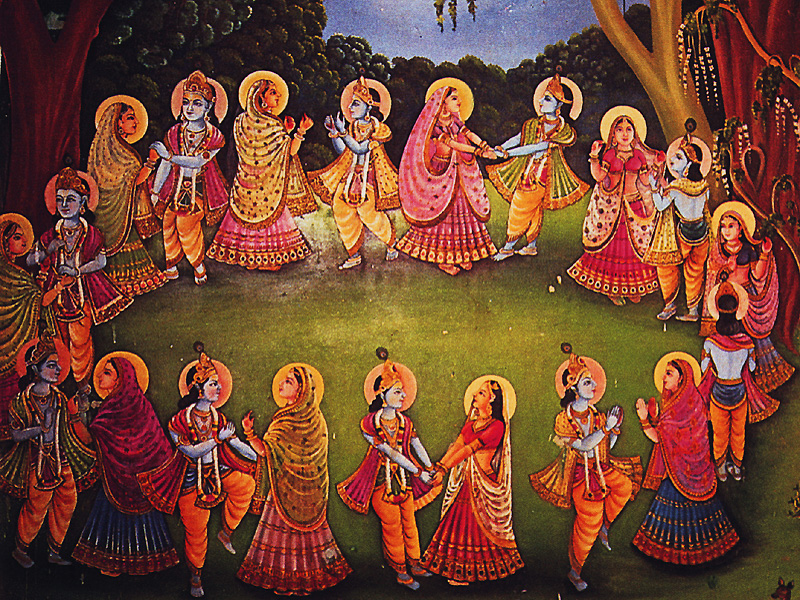
There are various festivities where Lord Krishna’s rasa lila is celebrated – this festival being just one of them. The purnima or full moon of Damodara month is the second full moon of the autumn season, and rasa lila is again celebrated.

This second rasa yatra is celebrated more in Bengal, whereas the first one is celebrated more in Vrindavana. On this day one should perform full worship of Radha and Krishna with many flowers, and place them in a rasa mandapa surrounded by the gopis.

Sri Krishna Vasant Rasa is similar excepting that it is in the Spring (Vasant), at this time everyone dresses in yellow. On this full moon night the devotees usually leave out pots of sweet rice payasam for the Lord to enjoy during His rasas.

Read more…
Views: 7
Comments: 0

Srila Narottama Dasa Thakura Appearance

Pastimes of Narottama Dasa Thakura

Narottama-Dasa-Thakura-4.jpg

I take refuge at the lotus feet of Lokanatha Prabhu, who is completely indifferent to the pains and pleasures of this material world. His mercy was fully realized only by the great scholar Narottama dasa. All glories to Narottama dasa Thakura, the beloved disciple of Lokanatha Goswami. How the illustrious Narottama took his birth in the house of Krishnananda Datta, the elder brother of Sri Purusottama, I dare not discuss elaborately here. However, for your pleasure, I shall give a brief description.

One day while Chaitanya Mahaprabhu was dancing with his associates during sankirtana, He suddenly looked in the direction of Sri Kheturi village. A peculiar look appeared on His face, tears whelmed up in His eyes, and He cried out the name "Narottama! Narottama!" again and again. The ocean of mercy Nityananda Raya shouted in joy, and Haridasa, Vakreshvara, and others were inexplicably filled

Read more…
Views: 8
Comments: 0

Nityananda Trayodasi

image034.jpg

From Caitanya Bhagavata, Adi-lila, Chapter Nine

Chapter Summary

     This chapter describes the childhood pastimes of  Nityananda up to his twelfth year, during which time he re-enacted the divine pastimes of Krsna, Rama, Vamana,  and the other avataras of Vishnu.  This chapter also describes his tour of different holy places which continued until his twentieth year.

     On the order of  Gaura Krsna, Ananta Deva had already made his appearance in the village of Ekacakra in Radades.  In this way, Nityananda Prabhu appeared like the moon from the sea of  the womb of Padmavati, the wife of Hadai Oja.  And just like the rising moon, he dispelled all the darkness covering the land of Radha by his auspicious appearance.  As a child,  Nityananda constantly played with his boyhood friends imitating the pastimes of Krsna.

     Once, his friends took the role of the assembly of gods, who were desirous of petitioning the Lord to relieve the burden of evil oppressing the Earth.  Nityananda Prabhu too

Read more…
Views: 11
Comments: 0

"So this is position. Therefore, because we are Krsna conscious, we are servants of God, therefore it is our duty to save this human civilization. You see. Krsna wants it. ...
...So there is the necessity of war with the demons..." Srimad-Bhagavatam Lecture 1.2.14 Los Angeles, August 17, 1972

So, as i have been saying despite so much opposition from cowards, you cannot sit on your ass ringing bells and think you are doing Krsna any service. Srila Prabhupada is unlike all the others, he wants full revolution from top to bottom.

Image may contain: 1 person
Read more…
Views: 8
Comments: 0

Varaha Dvadasi

Bhu-Varaha-Swamy-680x1024.jpg

Varahadeva is the boar incarnation Sri Krsna. He assumed the form of a boar to lift the drowning planet earth from the Garbhodaka Ocean with His tusks.

The demon Hiryanyaksa had thrown the planet earth into this ocean, but the Lord stabbed the demon with His tusks and saved the earth. After describing the appearance of the white Boar Incarnation that had appeared during the Svayambhuva devastation, Maitreya next described the red Boar Incarnation that had appeared during the Chakshusha devastation. Maitreya related these pastimes to Vidura in the same manner in which he had heard them long ago when Lord Brahma had narrated them to the demigods.

Once upon a time, at sunset, Kashyapa, the son of Marichi, was offering oblations to Lord Vishnu into the sacrificial fire. At this time, his wife, Diti, approached him due to being greatly afflicted by sex desire. Without trying to attract him gradually by her bodily expressions, the beautiful Diti frankly begged her husband, “O learned one, Cupi
Read more…
Views: 9
Comments: 0

Srila Ramajunacharya Disappearance

RamanujacharyaRamanujacharya

   When the religion of the Vedas became weakened due to the influence of less intelligent men who blindly performed ritualistic ceremonies and wantonly killed animals in the name of Vedic injunctions, Buddha appeared on the scene as a great reformer. Totally rejecting the Vedic literature and substituting his rational, atheistic views, Buddha advocated the path of ahimsa, (nonviolence and nirvana-the negation of reality as we know it) as the ultimate goal of life. Soon after, the philosophy of Shankaracharya overpowered Buddhism and spread throughout India.

   The authority of the Upanishads and other Vedic literature were revived by Shankara and employed as weapons to fight the Buddhist doctrine. Interpreting the Vedas to draw a particular conclusion, Shankara established the doctrine of non-dualism, adwaita-vedanta, stating that all living entities were on an equal level with God. He prominently stressed those texts which afforded an answer to the rationalistic atheism

Read more…
Views: 12
Comments: 0

Srila Madhvacarya Disappearance

Madhvacharya

Madhvacharya took diksha at age five, sannyasa at twelve and left home. He appeared with a mission to fight and defeat Sankara's Mayavada (impersonal) philosophy. By giving a pure interpretation of Vedanta-sutra he promoted pure theism. He named his innovative shastric explanation dvaita-dvaita-vada (pure dualism). (In the image: Shrila Madhvacharya).

   Shri Madhvacharya appeared in 1238 A.D. near Udupi, Karnataka in South India. He was considered an incarnation of Vayu (wind god). He had an unusually strong physique and extraordinary intellectual power. Once a fierce Bengali tiger attacked Madhvacharya's sannyasa disciple, Satya Tirtha. Madhvacharya wrestled the tiger and sent him away with his tail between his legs. Madhvacharya took diksha at age five, sannyasa at twelve and left home. He appeared with a mission to fight and defeat Sankara's Mayavada (impersonal) philosophy. By giving a pure interpretation of Vedanta-sutra he promoted pure theism. He named his innovative shastric ex

Read more…
Views: 7
Comments: 0

Bhismastami

bhismastami.jpg

Bhismastami is the appearance anniversary of Bhismadeva, the “grandfather” of the Pandavas. Bhishma's name in his boyhood was Devavrata.


Geneology:
From Vishnu were descended in the following order – Brahma-Atri-Candra-Budha – Pururavas – Ayus – Nahusha- Yayati – Puru – Janamejaya – Prachinvaa – Pravira – Namasyu – Vitabhava – Shundu – Bahuvidha – Samyati – Rahovadi – Raudrasva – Matinara – Santurodha – Dushyanta – Bharata – Suhotra – Gala – Gardda – Suketu – Brhatksetra – Hasti – Ajamidha – Riksha – Samvarana – Kuru – Jahnu – Suratha – Vidaratha – Sarvabhauma – Jayatsena – Ravyaya – Bhavuka – Chakroddhata – Devatithi – Riksha – Bhima-Pratipa-Shantanu-Bhishma.
 

Birth and Boyhood:
Bhishma's name in his boyhood was Devavrata. He was the eighth son of Shantanu, a king of the lunar dynasty and Gangadevi. This boy was the human embodiment of Dyau, one of the Ashthavasus. Shantanu, his father was the re-birth of another king, Mahabhisheka. The story concerning this is given in the Mahabharata

Read more…
Views: 7
Comments: 0

Advaita Acharya Appearance

Advaita-Acharya.jpg
 

He is a disciple of Madhavendra Puri, and constitutes one of the figures amongst the Pancatattva. He is the combined incarnation of Lord Mahavishnu and Lord Sadashiva. He was born in a varendra brahmana family on the seventh day of the bright fortnight in the month of Magha, 1355 Saka (1433 AD), in the village named Lauda in Srihatta.

According to Bangabhasa O Sahitya, Advaita Prabhu was born in 1434 AD  and met Vidyapati in 1458 AD. Advaita's former name was Kamalaksha (Kamalakanta) Vedapancanana. His two wives were Sita Devi and Sri Devi. Acyutananda was born of Sita Devi (1425 Saka 1503 AD), followed by Krsnadasa, Gopala, Balarama, Svarupa, and Jagadisa Misra. While Sri 
Devi gave birth to one son named Syamadasa (Premavilasa 24).

From Lauda, Advaita Prabhu migrated to the village of Navahatta and later to Santipura. He also had a house at Navadvipa. In 1480 Saka (1558 AD), at the age of 125 years (i.e. 25 years after the disappearance of Lord Gauranga) Advaita Prabhu returned to the

Read more…
Views: 9
Comments: 1

Srimati Vishnupriya devi Appearance

 VisnupriyaDevi.jpg

The Supreme Lord Visnu has three different Saktis: Sri, Bhu, and Nila. Sri Visnupriya is the internal potency known as Bhu-sakti. She appeared in Gaura-lila to assist Sri Caitanya Mahaprabhu with his mission of spreading the holy name of Krsna.

     In Nabadwipa-dhama there lived a brahmana named Sanatana Misra, who was an extremely exalted Visnu-bhakta. He was a pious and generous brahmana as well, and used to feed, clothe and shelter many people. He was famous as the king of panditas.  In fact, in Dvapara-yuga, he had been a king named Satrajit.  As a result of his pure devotion to Visnu he was blessed with a beautiful daughter who was rich in all good qualities. From her early childhood, Visnupriya devi used to bathe in the Ganges three times daily. She was devoted to her parents and carefully followed the scriptural principles, and performed puja, arcana, and served the tulasi tree, while observing many different vows of austerity and piety.

     Every day, when Visnupriya went to v

Read more…
Views: 14
Comments: 0

Sarasvati Puja

32659570235_a72f114eeb_b.jpg

O jiyat kaisora-caitanyo
murti-matya grihasramat
lakshmyarcito ’tha vag-devya
disam jayi-jaya-cchalat

TRANSLATION

Long live Lord Caitanya Mahaprabhu in His kaisora age! Both the goddess of fortune and the goddess of learning worship Him. The goddess of learning, Sarasvati, worshiped Him in His victory over the scholar who had conquered all the world, and the goddess of fortune, Lakshmi devi, worshiped Him at home. Since He is therefore the husband or Lord of both goddesses, I offer my obeisances unto Him. (Sri Chaitanya Charitamrta. Adi lila 16:3.)

kamais tais tair hrita jnanah
prapadyante ’nya-devatah
tam tam niyamam asthaya
prakritya niyatah svaya

“Those whose minds are distorted by material desires surrender unto demigods and follow the particular rules and regulations of worship according to their own natures.” (Bg. 7.20)

Read more…
Views: 9
Comments: 0

Vasanta Pancami

mayapur3.jpg

This is the first day of spring in India. On the fifth day of the waxing moon one should celebrate the coming of spring to Vrindavana by offering Krishna many types of leaves and flowers, and fresh shoots of sprouting grasses.

Things that symbolise life and new growth.Following in the footsteps of the Vraja-basis of Vrindavana, one should paint designs on His (Krishna’s) body and perform a special aratrika for Him. It is appropriate to offer yellow flowers too. The vasanta raga should be played on this day. The Deities in the temples, especially in Vrindavana wear yellow or yellow and green on this day.

In places like Vrindavan, Mayapur, Jagannath Puri and Udupi many of the women folk dress in yellow also. As it is the first day of spring many fertility rites are performed at this time – for the family, for the women folk, for the crops, for the cows, etc. It’s a very festive time.

Many new projects are begun, weddings performed…….
fields of yellow mustard flowers growing

Read more…
Views: 9
Comments: 0