All Posts (4075)

Sort by

Vasanta Pancami

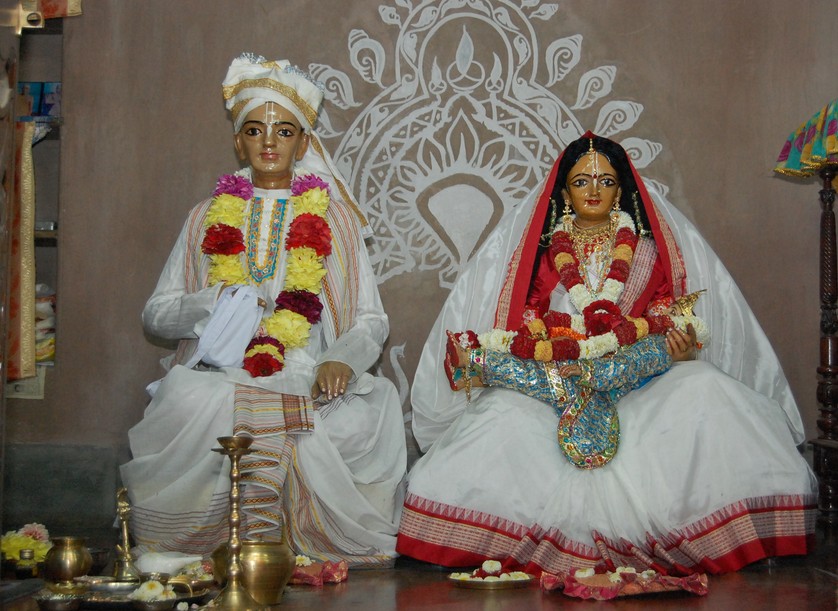
mayapur3.jpg

This is the first day of spring in India. On the fifth day of the waxing moon one should celebrate the coming of spring to Vrindavana by offering Krishna many types of leaves and flowers, and fresh shoots of sprouting grasses.

Things that symbolise life and new growth.Following in the footsteps of the Vraja-basis of Vrindavana, one should paint designs on His (Krishna’s) body and perform a special aratrika for Him. It is appropriate to offer yellow flowers too. The vasanta raga should be played on this day. The Deities in the temples, especially in Vrindavana wear yellow or yellow and green on this day.

In places like Vrindavan, Mayapur, Jagannath Puri and Udupi many of the women folk dress in yellow also. As it is the first day of spring many fertility rites are performed at this time – for the family, for the women folk, for the crops, for the cows, etc. It’s a very festive time.

Many new projects are begun, weddings performed…….
fields of yellow mustard flowers growing

Read more…
Views: 6
Comments: 0

Srila Raghunatha Dasa Goswami Appearance

srila-raghunath-das-goswami.jpg
Raghunatha dasa Gosvami used to reside on the bank of Sri Radha-kunda. At that time Radha-kunda was just a small pond of water, and therefore sometimes Raghunatha would meditate on enlarging the kund. Then he would chastise himself for desiring something which would require a large amount of money.

Around this time one very wealthy Seth underwent great austerity by walking to Badarikasrama in the Himalayas. Arriving there he very reverently worshiped Sri Badrinarayana and offered much wealth at His lotus feet. That night as he slept there, he had a dream in which Sri Badarinarayana instructed him to proceed to Vraja, where he should present all his wealth to Sri Raghunatha Dasa Gosvami, who was residing at Aritgram. "If he declines to accept it, then you can mention My name and remind him about renovating Radha-kunda and Shyama-kunda."

That Seth was very happy to have seen such a wonderful dream and after returning to his home he very joyfully set out for Vraja. There he met Raghunatha d
Read more…
Views: 10
Comments: 0

Srila Raghunandana Thakura Appearance

  Raghunandana-Thakura.jpg

Shri Mukunda Dasa, Shri Madhava Dasa and Shri Narahari Sarakara Thakura were three brothers who lived in Shri Khanda. Shri Mukunda Dasa Thakura's son was Shri Raghunandan Thakura. Mukunda Dasa Thakura was the doctor in the court of the muslim king. He was always absorbed in Krishna, whatever work he did.

     An example of this is found in what happened to Mukunda Dasa one day when he went to the court of the king to give him some medical advice. The king was seated on an elevated throne. Mukunda Dasa sat before him, a little lower, on a half-elevated seat, and began inquiring about his health. At taht time a servant came with a large peackock fan to fan the king.  The sight of peacock feathers filled Mukunda with a deep memory of Krishna's pastimes. He fainted.  When the king saw Mukunda laying on the ground he was alarmed.  He thought, "Is he dead?" Gradually they managed to bring him back to consciousness. The king asked him, "What is the nature of your disease?" Shri Mukunda Dasa

Read more…
Views: 14
Comments: 0

Srila Sri Pundarika Vidyanidhi Appearance

   Pundarika-Vidyanidhi.jpg

A disciple of Sri Madhavendra Puri, Pundarika Vidyanidhi was Sri Gadadhara Pandit's guru, and an intimate friend of Svarupa Damodara.

    Once in Jagannatha Puri, Pundarika Vidyanidhi met Svarupa Damodara after a long separation. In a joyful mood of friendship Pundarika and Svarupa wanted to take the dust from each other's feet. A scuffle began as they tried to simultaneously catch the feet of one another, but at the same time, avoid having their own feet caught. Both being quite strong, neither won. But Sri Gauranga enjoyed their sporting play and everyone laughed.

    Pundarika Vidyanidhi has other names—Sri Vidyanidhi, Acaryanidhi, Bhaktyanidhi, and Premanidhi (given by Lord Caitanya). "Simply by hearing his name," said Sri Gaura, "the whole world becomes purified." Premanidhi's pure devotion caused Sri Caitanya Mahaprabhu to sometimes cry profusely and call out loudly, "Bop, (father) Pundarika! Pundarika is My father, My dearmost friend. When will I see him again?" Pundarika Vidya

Read more…
Views: 11
Comments: 0

viswanath_chakravarti_02_w_iskcondesiretree.jpg

Vishvanatha Chakravarti Thakura was one of the most prominent, influential, and prolifically literate teachers in the disciplic succession of Krishna devotees. He appeared in 1662 in the village of Devagram, Bengal. He received initiation from Ramana Chakravarti, and his name after taking sannyasa (renounced life) was Hari Vallabha Goswami.

Srila Bhaktisiddhanta Saraswati Thakura, a later acharya in the disciplic succession, writes: “To serve the feet of Narottama dasa Thakura was the only desire of Vishvanatha Chakravarti Thakura, who was the fourth acharya in disciplic succession from Narottama dasa.” Srila Vishvanatha Chakravarti Thakura wrote more than forty Sanskrit books, including commentaries on Bhagavad-gita, Srimad-Bhagavatam, and the writings of the six Goswamis of Vrindavan.

Srila Prabhupada regularly referred to Vishvanath Chakravarti Thakura's Srimad-Bhagavatam commentaries while writing his own purports.

Read more…
Views: 18
Comments: 0

Every living being, out of many, many billions and trillions of living beings, has a particular relationship with the Lord eternally

"…Bhagavad-gītā is best understood by a person who has qualities similar to Arjuna's.

That is to say he must be a devotee in a direct relationship with the Lord.

As soon as one becomes a devotee of the Lord, he also has a direct relationship with the Lord.

That is a very elaborate subject matter, but briefly it can be stated that a devotee is in a relationship with the Supreme Personality of Godhead in one of five different ways:

1. One may be a devotee in a passive state;
2. One may be a devotee in an active state;
3. One may be a devotee as a friend;
4. One may be a devotee as a parent;
5. One may be a devotee as a conjugal lover.

Arjuna was in a relationship with the Lord as friend.

Of course there is a gulf of difference between this friendship and the friendship found in the material world.

This is transcendental friendship

Read more…

Now, from this we may take the lesson that in our fight with māyā we should not be in a position in which our strength, enthusiasm and senses will be unable to fight vigorously. Our Kṛṣṇa consciousness movement has actually declared war against the illusory energy, in which all the living entities are rotting in a false understanding of civilization. The soldiers in this Kṛṣṇa consciousness movement must always possess physical strength, enthusiasm and sensual power. To keep themselves fit, they must therefore place themselves in a normal condition of life. What constitutes a normal condition will not be the same for everyone, and therefore there are divisions of varṇāśrama—brāhmaṇa, kṣatriya, vaiśya, śūdra, brahmacarya, gṛhastha, vānaprastha and sannyāsa. Especially in this age, Kali-yuga, it is advised that no one take sannyāsa.

aśvamedhaṁ gavālambhaṁ
sannyāsaṁ pala-paitṛkam
devareṇa sutotpattiṁ
kalau pañca vivarjayet
[Cc. Ādi 17.164]

(Brahma-vaivarta Purāṇa)

From this we can underst

Read more…

Ganga Sagara Mela

28741d828598682c042941b04b783a1e.jpg

On January 13th, 1976, Srila Prabhupada was visiting the Calcutta Hare Krishna temple on Albert Road. With him was his disciple Hari-Sauri dasa, who writes about that year's Ganga Sagara Mela:

"Today was Ekadasi, and Srila Prabhupada took his morning walk along the Ganga. Hundreds of pilgrims were taking a dawn bath there, having come for the Ganga-Sagara-mela. Prabhupada explained that sagara is the sea, so the mela is a spiritual gathering on an island in the Ganga's estuary.

Evidently eager pilgrims had traveled from as far away as Rajasthan in the northwest. They camped along the banks of Mother Ganga, washing their few possessions, as well as themselves, in the holy waters, unmindful of the boats and other river traffic passing by. They sat contentedly on the pathways cooking breakfast and drying out their clothing.

Noting the shining lota (combination waterpot and drinking vessel) one man carried, Prabhupada remarked that if even the lota is so clean, we can understand how cle

Read more…
Views: 14
Comments: 0

THE FAMILIES OF HIS PREVIOUS BIRTHS

SB 7.10.18

TRANSLATION
The Supreme Personality of Godhead said: My dear Prahlāda, O most pure, O great saintly person, your father has been purified, along with twenty-one forefathers in your family. Because you were born in this family, the entire dynasty has been purified.
PURPORT
The word triḥ-saptabhiḥ means seven multiplied by three. In one’s family one can count back four or five generations—to one’s great-grandfather or even one’s great-grandfather’s father—but since the Lord mentions twenty-one forefathers, this indicates that the benediction expands to other families also. Before the present family in which one has taken birth, one must have been born in other families. Thus when a Vaiṣṇava takes birth in a family, by the grace of the Lord he purifies not only that family but also the families of his previous births.

Image may contain: 10 people, people smiling, people standing

Comment

Read more…
Image may contain: flower, bird, outdoor and nature

Nondevotee; hastled endlessly by corrupt demons, eventually wants to escape material existence, takes to devotional service imitation

Neophyte; Wants to find liberation, therefore starts to build an internal dream world of "service", composed of pretty pictures of Sri Krsna and endless repeated ritual. Thinking themselves now advanced compared to the "karmis", they criticize real and advanced devotees, saying, "oh, they are involved with politics and everything (I am rightly running away from like a scared rabbit), those prabhus are in maya!"

Advanced devotee; Realizing that they are eternal servants of Radha Krsna, now, no matter where they are, they are actually doing something REAL in THIS LIFE HERE AND NOW, as best they can, to fix things, as desired by Sri Gurudeva, including fielding insults from neophytes who say the actual devotees are in maya for fighting to the very death to fix things. An advanced devotee is Krsna conscious, and at the same time is

Read more…

It is funny how the whole world believes that the 7 day week is a western concept!

7 day week is not a concept borrowed from Romans as it is generally believed.

The 7 day week is not really based on western calendar. Firstly, lets look at how classic predictions ( Jyothisha Shastra ) of the Vedas for answers to these questions:

Why do we have only 7 days in a week? Why can't we have 8 or 9? 
What is an hour? 
Why do we have only 24 hours in a day? Why can't we have 30 or 40 units and call it an hour?

Ancient Indians were so well versed that they often used 4 to 5 different units of time. If you ask your Indian grand mother, she might have told you that during her days, people measured time in a weird unit called ghati/ghadiya (1 ghati = 24 minutes).

1 day is the time lapsed between two sunrises. Sandhi in sanskrit means knot or junction and hence the junction points are named as pratah sandhya(Early morning) and sayam sandhya (Evening) which divide the standard day

Read more…

Lochana-Dasa-Thakura-3.jpg

He mentions an especially touching conversation Shri Gaurasundara had with Vishnupriya Devi the night before He took sannyasa. Being a talented musician, Lochana Dasa told Mahaprabhu's pastimes in beautiful poetry filled with fire and rhythm. Common people could easily understand the divine character of Shri Chaitanya and awaken their religious feelings. As Devotees regularly chant the Vedic epics Ramayana and Mahabharata, Gaudiya Vaishnava's still wander through Bengal reciting the Chaitanya Mangala. (In the image: Shri Gaurachandra, ISKCON Chowpatty, Mumbai).

Shri Lochana Dasa Thakura was a disciple of Shri Narahari Sarakara Thakura, a dearest associate of Lord Gaura Raya.

"My hope of hopes is to be near the lotus feet of Shri Narottama Dasa Thakura and serve him with my very life. The cherished desire of the fallen Lochana Dasa is to be allowed, by Narahari's grace, to sing the glories of Lord Gauranga. My Lord is Shri Narahari Thakura, I am His servant. Bowing before him I beg fo

Read more…
Views: 17
Comments: 0

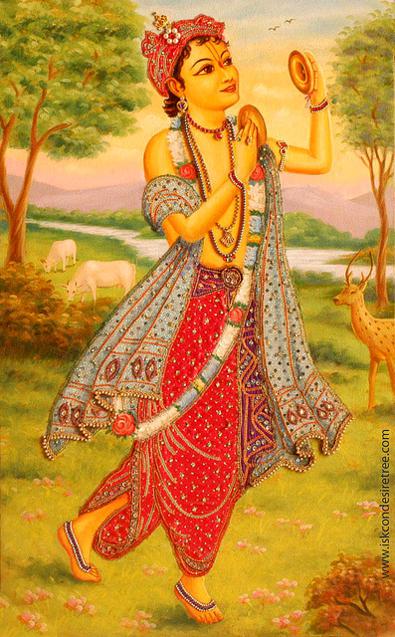
Ramachandra-Kaviraja-3.jpg

Srila Narottama dasa Thakura Mahasaya has sung: "O Acarya Prabhu (Srinivasa), please bestow your mercy upon me. I pray that I might also have the association of Ramacandra."

Sri Ramacandra Kaviraja was the disciple of Srinivasa Acarya Prabhu and the very intimate friend of Narottama dasa Thakura. His father was Ciranjiva Sena and mother Sri Sunanda. Ciranjiva was originally an inhabitant of Kumara nagar but after marrying the daughter of Sri Damodara Kavi he moved to Sri Khanda.

"Ciranjiva Sena was a pure devotee very much loved by Narahari Sarkar and the other residents of Sri Khanda. He was extremely learned in all matters and his wife was very chaste and gentle. Her activities were completely transcendental." [C.C Mad. 11/92]

Sri Mukunda, Narahari, Raghunandana and Ciranjiva, who were all residents of Sri Khanda, were of one mind and one purpose. Every year they would come to Nilacala to have darshan of Mahaprabhu and to chant and dance in front of Lord Jagannatha during Ratha Ya

Read more…
Views: 8
Comments: 0

Srila Gopal Bhatta Goswami Appearance

Gopala Bhatta Goswami

Shri Gopala Bhatta Goswami.

   Shri Gopala Bhatta Goswami (the son of a Vyenkata Bhatta, a Shri Vaishnava brahmana) appeared in Shri Rangam, South India. Lord Chaitanya once stayed four months in his home, and converted the family to Gaudiya Vaishnavism. A mere boy at this time, Gopala personally served the Lord. Shri Chaitanya treated him affectionately giving His remnants and blessings to' become an acharya.

   During His four month stay, Lord Chaitanya developed a close friendship with Vyenkata Bhatta, which Krishna Dasa Kaviraja describes as "sakhya rasa." Freely conversing with each other, they would often laugh and joke together. One day in a humorous mood Lord Chaitanya asked Vyenkata:

   "Why does your worshipable goddess of fortune, Shri Lakshmidevi, abandon the happiness of Vaikuntha and her service to Her Lord Narayana? Why does she go to Vrindavana and perform severe austerities to attain the association of My Lord Gopala, the cowherd boy of Vraja?"

   "I can't understand these

Read more…
Views: 9
Comments: 0

Srila Jayadeva Goswami Disappearance

Jayadeva Goswami is the author of the Gita-govinda, a poem about the pastimes of Sri Sri Radha-Krishna. He appeared 300 years before the advent of Chaitanya Mahaprabhu. Lord Chaitanya relished hearing the Gita-govinda sung by His close associates. To this day the poem is recited daily in the temple of Lord Jagannatha in Jagannatha Puri, Orissa. Jayadeva Goswami is also the author of the famed Dashavatara Stotra.Here's the fourth verse from Jayadeva's Dashavatara Stotra, which is chanted in Krishna temples every day:tava-kara kamala vare nakham adbhuta sringamdalita hiranyakashipu tanu bringhamkeshava-dhrita narahari rupa jaya jagadisha hare"O Keshava! O Lord of the universe! O Lord Hari, who have assumed the form of half-man, half-lion! All glories to You! Just as one can easily crush a wasp between one's fingernails, so in the same way the body of the wasplike demon Hiranyakashipu has been ripped apart by the wonderful pointed nails on Your beautiful Lotus hands."
Read more…
Views: 9
Comments: 0

Srila Jayadeva Goswami Disappearance

Jayadeva Goswami is the author of the Gita-govinda, a poem about the pastimes of Sri Sri Radha-Krishna. He appeared 300 years before the advent of Chaitanya Mahaprabhu. Lord Chaitanya relished hearing the Gita-govinda sung by His close associates. To this day the poem is recited daily in the temple of Lord Jagannatha in Jagannatha Puri, Orissa. Jayadeva Goswami is also the author of the famed Dashavatara Stotra.Here's the fourth verse from Jayadeva's Dashavatara Stotra, which is chanted in Krishna temples every day:tava-kara kamala vare nakham adbhuta sringamdalita hiranyakashipu tanu bringhamkeshava-dhrita narahari rupa jaya jagadisha hare"O Keshava! O Lord of the universe! O Lord Hari, who have assumed the form of half-man, half-lion! All glories to You! Just as one can easily crush a wasp between one's fingernails, so in the same way the body of the wasplike demon Hiranyakashipu has been ripped apart by the wonderful pointed nails on Your beautiful Lotus hands."
Read more…
Views: 6
Comments: 0

Srila Jayadeva Goswami Disappearance

jaydev-goswami_big.jpg

Jayadeva Goswami is the author of the Gita-govinda, a poem about the pastimes of Sri Sri Radha-Krishna. He appeared 300 years before the advent of Chaitanya Mahaprabhu. Lord Chaitanya relished hearing the Gita-govinda sung by His close associates. To this day the poem is recited daily in the temple of Lord Jagannatha in Jagannatha Puri, Orissa. Jayadeva Goswami is also the author of the famed Dashavatara Stotra.

Here's the fourth verse from Jayadeva's Dashavatara Stotra, which is chanted in Krishna temples every day:

tava-kara kamala vare nakham adbhuta sringam
dalita hiranyakashipu tanu bringham
keshava-dhrita narahari rupa jaya jagadisha hare

"O Keshava! O Lord of the universe! O Lord Hari, who have assumed the form of half-man, half-lion! All glories to You! Just as one can easily crush a wasp between one's fingernails, so in the same way the body of the wasplike demon Hiranyakashipu has been ripped apart by the wonderful pointed nails on Your beautiful Lotus hands."

Read more…
Views: 9
Comments: 0

Sri Krishna Pushya Abhishek

DSC08106-1024x680.jpg

Srila Prabhupada once explained the festival this way: “Krishna was just a toy in the hands of the Gopis, so one day the Gopis decided that we shall decorate Him. Pusya abhisheka means a ceremony to decorate the deity profusely with flowers, ornaments, cloths.

After there should be lavish feasting and a procession through the streets, so that all the citizens should see how beautiful Krishna appears.”

Read more…
Views: 18
Comments: 0