These excerpts have been taken from Satswarup dasa Goswami's Prabhupada-lilamrita ch 11-12.
All Posts (4076)
Second month: No yoghurt (if one requires it for health, it can be mixed with water)
Caturmasya stands for ‘four months’. It is the period between sayana and uttana ekadasis. The scriptures refer to this period as the duration of Lord Visnu’s sleep in this universe.
Who is Lord Balarama?
The Supreme Personality of Godhead, Krishna, is the fountainhead of all incarnations. Lord Balarama is His second body. They are both one and the same identity. They differ only in form. Balarama is the first bodily expansion of Krishna, and He assists in Lord Krishna's transcendental pastimes. He is the source of the entire spiritual world and is the adi-guru, the original spiritual master.
He assumes five other forms to serve Lord Krishna. He Himself helps in the pastimes of Lord Krishna, and He does the work of creation in four other forms called the catur-vyuha (four armed) forms known as Vasudeva, Sankarshana, Pradyumna and Anirudha. He executes the orders of Lord Krishna in the work of creation, and in the form of Lord Sesa He serves Sri Krishna in various ways. In all the forms He tastes the transcendental bliss of serving Krishna. No one can approach Krishna without first getting the mercy of Baladeva.
Descent of Balarama
Whenever Krishna appears in the materi
Hayagriva Jayanti is the birth anniversary of Lord Hayagriva who is considered the incarnation of Lord Vishnu. It is believed that Lord Hayagriva restored all Vedas to Brahma.
Hayagriva is a unique incarnation of Lord Vishnu with the head of a horse and the body of a human being. The purpose of this Avatar was to retrieve the stolen Vedas from the demons. The day is observed asUpakarma day by Brahmin community.

In 1517, Shri Rupa Goswami and Shri Sanatana Goswami, his elder brother, came to Vrindavana to fulfill four orders of Lord Chaitanya's: (1) Uncover Shri Krishna's lost pastime places. (2) Install Deities, start puja. (3) Write bhakti-shastras. (4) Propagate the rules of bhakti-yoga. (In the wallpaper: Rupa amd Sanatana Goswamis, Lord Shri Gopintha in Jaipur and Temple of Madan Mohan, Shri Vrindavan Dham).
In 1517, Shri Rupa Goswami and Shri Sanatana Goswami, his elder brother, came to Vrindavana to fulfill four orders of Lord Chaitanya's:
(1) Uncover Shri Krishna's lost pastime places.
(2) Install Deities, start puja.
(3) Write bhakti-shastras.
(4) Propagate the rules of bhakti-yoga.
Wearing only kaupina (loincloth) and kantha (patchwork quilt), Shri Rupa Goswami lived a mendicant's life absorbed in hearing, chanting, writing about Radha-Govinda's sweet loving pastimes in Shri Vrindavana-dhama. More details of his conduct and character are mentioned in Sanatana Goswami's b

"Gauridasa, My Murti form is as good as I am," said Lord Gauranga, "We will forever remain in your home to accept your service." (In the image: Shri Shri Gaura Nitay Deities of Shrila Gauridasa Pandit).
"Gauridasa Pandit, the emblem of the most elevated devotional service in love of Godhead, had the greatest potency to receive and deliver such love. Making Lord Chaitanya and Lord Nityananda the Lords of his life, Gauridasa Pandit sacrificed everything for the service of Lord Nityananda."( Chaitanya-charitamrta).
Before taking sannyasa, Lord Chaitanya and Lord Nityananda visited Gauridasa Pandit in Ambika Kalna. Fearing their impending separation, Gauridasa cried and begged the Lord to stay longer. Mahaprabhu made life-like neem wood Deities of Gaura-Nitai to console his loving servant. "Gauridasa, My Murti form is as good as I am," said Lord Gauranga, "We will forever remain in your home to accept your service."
Gauridasa Pandit worshiped Gaura Nitai in many intimate ways–talk
The swing festival of Radha-Krsna. The Deities ride on an elaborately decorated swing.
Deities in the temples are swung on a swing. Some of the main temples that this festival is celebrated at are the Banke Bihari Temple and the Radha-Raman Temple in Vrindavana, the Dwarkadish temple in Mathura, and the Larily Lal Temple in Varsana.
In our Iskcon temples we observe for five days in accordance with Srila Prabhupada's instructions. So whether one observes for the four days or for the seven, or thirteen days, the same festival is put on for the pleasure of the Lord and His loving associates.
This is a wonderful ceremonial function of Lord Krishna's pastimes that reflects practically how we are to render service to the Lord for His pleasure.
At the time of the Jhulan Yatra festival it is Monsoon in India and the air is thick, heavy and humid with the heat and the rains. In the midst of the rainy season, when fields and jungle have turned shades of lush green and flowers are blossoming all arou
Hare Krsna!
My friend, Kripamaya has been working for years on a staged musical version of Ramayana. It is now ready to be performed live for the first time. If you are in the general area, please attend.
"There are always rogues and thieves in human society, and as soon as a weak government is unable to execute its duties, these rogues and thieves come out to do their business. Thus the entire society becomes a hell unfit for gentlemen to live in.
There is an immediate need for a good government -- a government by the people, with Krsna consciousness. Unless the masses of people become Krsna conscious, they cannot be good men. The Krsna consciousness movement that Sri Caitanya Mahaprabhu started by chanting the Hare Krsna maha-mantra still has its potency. Therefore people should understand it seriously and scientifically and spread it all over the world."

SRILA PRABHUPADA: "Still fight must go on. Fight cannot be stopped. So fight like brave soldiers, Kṛṣṇa will help you. Don't make any compromise . .....Devotee: The outcome of the battle is already decided. Just like in Bhagavad-gītā, we've already won. We just have to keep, keep fighting. Prabhupāda: They are now feeling the pressure of the opposite party. So fight is fight. When there is fight, my Guru Mahārāja used to say, "Some of our soldiers will die. It doesn't matter." You don't expect that not a single soldier of your party will not die. No, some of them will die. Still fight must go on. Fight cannot be stopped. So fight like brave soldiers, Kṛṣṇa will help you. Don't make any compromise." Srila Prabhupada Room Conversation February 3, 1977, Bhuvanesvara


The deity of baby Raghunandana on the lap of his mother at his birthplace, Sri Khanda. Courtesy of Sakhicharan dasa.
Being called away on medical business, Mukunda Dasa once asked his young son, Raghunandana, to offer the raja bhoga to the family Deity of Gopinatha. Raghunandana prepared everything timely, carefully, and with great devotion. When he made the offering he remembered his father's order, "make sure the Deity eats." Ringing the bell the simple boy told the Gopinatha Deity, "Eat, eat!" Raghunandana began crying when he saw the untouched food remaining on the Deity's plate. He feared his father's anger for his inability to "make the Deity eat." Gopinatha couldn't resist the child's intense devotion. So the Lord ate everything on the plate, leaving no remnants.
Upon returning, Mukunda asked for Gopinatha's Maha-Prasadam. Raghunandana said the Deity ate everything. Astonished, Mukunda told his son to make the offering again. From a hidden place Mukunda watched in total ama
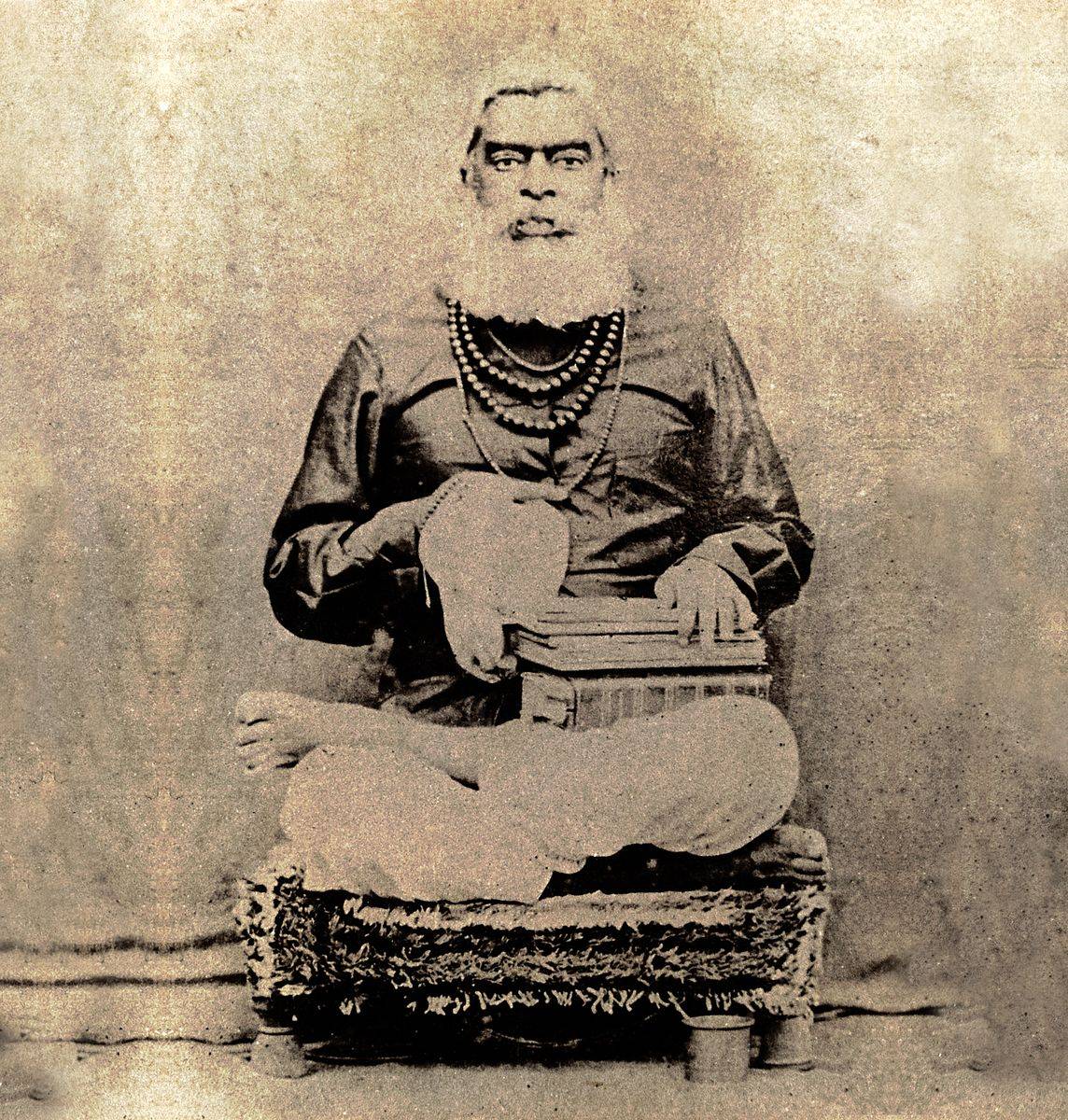
Vamsidas Babaji was a Gaudiya Vaishnav sadhu who lived at Swarupa Gunj, Navadwip during the time of Srila Bhaktisiddhanta Saraswati Thakur. He was respected by Srila Bhaktisiddhanta, and he used to see to it that Vamsidas Babaji was provided with grains and so on by Gaudiya Matha brahmacharis.
Srila Vamsidas Babaji appeared in the village of Majidpur in the Jamalpur district of Bangladesh. Before the partition of India, this city was formerly in the district of Mymensing. His father’s name was Sanatana Malobrahma and he was previously known as Bhairava. Babaji Maharaj came to Nabadwip from East Bengal.
He lived as a total recluse, far away from the hubbub of the town in a solitary place on the bank of Ganga near Baral Ghata in Navadvipa, as if he was a mad or crazy person. His only possessions were an old kaupina, karanga and kantha. Vamsidasa Babaji lived in a world of his own. His world centered round his deities-Gaura-Gadadhara, Nitai, Radha-Krishna and Gopala. For the service of his

His body and mind were completely attached to Vrindavanadhama. The divine Was of Radha-Vinoda played in his heart. His ears existed only to hear the Shrimad Bhagavatam. "Anyone who reads the Shrimad Bhagavatam," said Lokanatha Goswami, "he is my friend." (In the images: Shrila Lokanatha Goswami).
A personal associate of Lord Gauranga, fully absorbed in pure love, Shri Lokanatha Goswami was the eldest of the Goswamis living in Vraja-bhumi. He shunned name and fame so much that he asked Krishna Dasa Kaviraja to keep his name out of Chaitanya-charitamrta.
His body and mind were completely attached to Vrindavanadhama. The divine Was of Radha-Vinoda played in his heart. His ears existed only to hear the Shrimad Bhagavatam. "Anyone who reads the Shrimad Bhagavatam," said Lokanatha Goswami, "he is my friend."
.
Once Shri Krishna Himself appeared and gave Lokanatha a Deity of Radha-Vinoda. Lokanatha Goswami carried his Deity all over Vraja in a cloth bag hung around his neck.
Alth
Shri Gopala Bhatta Goswami.
Shri Gopala Bhatta Goswami (the son of a Vyenkata Bhatta, a Shri Vaishnava brahmana) appeared in Shri Rangam, South India. Lord Chaitanya once stayed four months in his home, and converted the family to Gaudiya Vaishnavism. A mere boy at this time, Gopala personally served the Lord. Shri Chaitanya treated him affectionately giving His remnants and blessings to' become an acharya.
During His four month stay, Lord Chaitanya developed a close friendship with Vyenkata Bhatta, which Krishna Dasa Kaviraja describes as "sakhya rasa." Freely conversing with each other, they would often laugh and joke together. One day in a humorous mood Lord Chaitanya asked Vyenkata:
"Why does your worshipable goddess of fortune, Shri Lakshmidevi, abandon the happiness of Vaikuntha and her service to Her Lord Narayana? Why does she go to Vrindavana and perform severe austerities to attain the association of My Lord Gopala, the cowherd boy of Vraja?"
"I can't understand these
Śrīla Prabhupāda Says - [Regarding how we should not have the attitude that Kṛṣṇa will handle our problems]
The God says that "Here is injustice, so you should fight." God says that. God never says that "I am God, Kṛṣṇa. I am your friend. You sit down idly and I shall do everything." He never said that. He said that "You must fight." That is our duty, not that God has given us hands and legs and you sit down idly and let God do it. This is not devotion.
[SB Lecture 1.2.6: Mauritious

First month: No leafy vegetables, such as spinach, salads of all types, cabbages of all types, kale, leafy herbs like coriander, mint, parsley, curry and powdered leafy herbs and teas.
Caturmasya stands for ‘four months’. It is the period between sayana and uttana ekadasis. The scriptures refer to this period as the duration of Lord Visnu’s sleep in this universe.
The appearance anniversary of Srila Vyasadeva, the compiler of the Vedic literature.
This event really is directed towards Srila Vyasadeva, thus in some sampradayas they refer to Guru Purnima as Vyasa Purnima. Traditionally it is the day when the guru is worshipped.
In the book Festivals, Fairs and Fasts of India (Shakti M Gupta. 1991. Clarion books. page 88-89.) It says: Guru Purnima "……is observed on the full moon day in the month of Ashadha in honour of the sage Vyasa, by keeping a fast, worshippig him for His blessings and to gain wisdom. Formerly on this day, gurus who were the traditional teachers, were honoured by their pupils.

Shri Sanatana Goswami appeared in 1488, five years before Shri Rupa Goswami, in a Sarasvata brahmana family in Bengal. Sanatana and his two brothers, Rupa and Anupama, were always absorbed in bhava bhakti from early childhood. Remembering Vrindavana, they named the forests in which they played after Vraja's twelve forests (Talavana, Madhuvana, Kamyavana, Mahavana). (In the image: Shrila Rupa and Shrila Sanatana Goswamis).
Shri Sanatana Goswami appeared in 1488, five years before Shri Rupa Goswami, in a Sarasvata brahmana family in Bengal. Sanatana and his two brothers, Rupa and Anupama, were always absorbed in bhava bhakti from early childhood. Remembering Vrindavana, they named the forests in which they played after Vraja's twelve forests (Talavana, Madhuvana, Kamyavana, Mahavana). They called their favorite bathing ponds Radha-kunda and Shyama-kunda.
In his youth, Shri Sanatana dreamed that a beautiful brahmana boy gave him a Shrimad Bhagavatam. Feeling ecstatic he awoke. But se
“I will always be the spiritual master for the entire Krishna consciousness movement; for anyone in this age willing to follow the principles I have given for the benefit of everyone.”
Srila Prabhupada’s Conversation 1975, Ookala, Hawaii