All Posts (4101)

Sort by

pilgrim notes; ANANDA VARDHAN

Ananda Vardhana dasa

pilgrim notes 24.01.11 - 12.02.11

Seems to me its not possible to practise tolerance unless you are practising humility ? What say you o wise ones ? Hare Krishna

Such a special world it will be
when every single creature
feels safe ,feels loved , feels at home. Hare Krishna

"You cannot ask the sun to appear immediately.When he is pleased he will appear in the morning.Similarly you have to please Krishna so that He will appear before you and talk with you and bless you. "Shrila A.C. Bhaktivedanta Swami Prabhupada

Each day its good to clear my heart of all the dust thats keeping us apart ,
so that I can see You as You really are ,
with no feeling other than the desire to siimply please You , my dear Lord.
In this way everyone else will also be pleased. Radhe Shyam

For many lifetimes my dear Srila Gurudeva , I have been uselessly serving my senses. On this your glorious Appearance Day I am reminded that you have come to instruct us in the ways of prema , Divine Love , teaching us that to

Read more…
Ranacora

The Purpose of Creation and Living in a Material World

Bhaktivedanta VedaBase: Śrīmad Bhāgavatam 9.24.58


yan māyā-ceṣṭitaḿ puḿsaḥ

sthity-utpatty-apyayāya hi

anugrahas tan-nivṛtter

ātma-lābhāya ceṣyate


TRANSLATION

The Supreme Personality of Godhead acts through His material energy in the creation, maintenance and annihilation of this cosmic manifestation just to deliver the living entity by His compassion and stop the living entity's birth, death and duration of materialistic life. Thus He enables the living being to return home, back to Godhead.


PURPORT

Materialistic men sometimes ask why God has created the material world for the suffering of the living entities. The material creation is certainly meant for the suffering of the conditioned souls, who are part of the Supreme Personality of Godhead, as confirmed by the Lord Himself in Bhagavad-gītā (15.7):


mamaivāḿśo jīva-loke

jīva-bhūtaḥ sanā

Read more…

Preaching to the 4 Walls; "Muktipada108" Prabhu

Hare Krishna. All glories to Srila Prabhupada. We are presenting to you the Preaching to the Four Walls istagosthi series. We have discovered that Srila Bhaktisiddhanta has inaugurated this preaching program for the age of kali. If you are too busy to view the Preaching to the Four Walls Istagosthi series you can simply turn the video on and leave the room and you will still make spiritual advancement. The living entities in the room will make advancement as well. Please send this series to all the devotees in the world through any means which you can find and the universe will be purified. If your friends don’t have time to watch the videos also, you can simply ask them to play the Preaching to the Four Walls Istagosthi series in their rooms so the living entities in the room will make advancement as well. Thank you! Hare Krishna. Jaya Srila Prabhupada.


Today, of course, we find that our, this small endeavor to preach this Hare Krishna mantra is not very successful, but it has got t

Read more…

Instruction in Gayatri, 7 final

Additional Meanings of Kama-gayatri

"Let us meditate upon that new transcendental Cupid of Vrndavana, Shri Krishna, who

is always enchanting and ever-youthful. By His desire, Syama plays in different

pastimes.

Let us try to know that Kamadeva, Shri Krishna, who has five arrows of flowers that

He shoots from the five threaded strings of His bow. Shri Krishna is Rasaraja, the king

of all the mellows of conjugal love, and He greatly pleases us by engaging us in His

transcendental loving service."

The Moons of Krishnacandra

kama'gayatri-mantra-rupa, haya krmera svarupa,

sardha'cabbisa aksara tara haya se aksara 'candra' haya, krsne kari'

udaya, trijagat kaila kamamaya

"Krishna, the Supreme Personality of Godhead, is identical (krsnera svarupa) with the

Vedic hymn known as the Kama-gayatri (kama-gayatri-mantra-rupa), which is composed

of twenty-four and a half syllables. Those syllables are compared to moons that arise

in Krishna. Thus all three worlds are filled with desire." (Cc. Madh

Read more…

Instruction in Gayatri, 5

The Kama-gayatri, however, is the highest of all the Gayatris because it

denotes the perfect transcendental sportive activities of Krishna and the gopis

in Vraja-dhama, a meditation not found in any other Gayatri.

Chanting the Kama-gayatri helps one attain pure love for Gopijanavallabha and

realizations of His blissful transcendental pastimes.

Unlike the Brahma-gayatri, which is chanted without exception by all classes of

brahmanas, the Kama-gayatri is specifically chanted by members of the

Gaudiya sampradaya.

trayyd prabuddho 'tha vidhir vysata'tattva-sagarah tustava veda-sdrena

stotrenanena kesavam

'Enlightened by the recollection of that Gayatri, embodying the three Vedas,

Brahma became acquainted with the expanse of the ocean of truth. Then he

worshiped Shri Krishna, the essence of all Vedas, with this hymn." (BS v. 28)

This verse indicates that by Gayatri meditation Lord Brahma became purified

and elevated to the madhyama level. In the beginning of his meditation Brahma

had to de

Read more…
Views: 104
Comments: 0

Instruction in Gayatri, 4

Benefits of Gopala-mantra

Of the many Vishnu mantras giving liberation, the Gopala-mantra (Krishnamantra)

is the best because it invokes Krishna-prema upon its chanter and

reveals Krishna's Vrndavana.

By chanting the Gopala-mantra, the mantra-raja (king of mantras), one

propitiates Radha-Govinda in madhurya-rasa.

"Do execute penance while contemplating upon this mantra, and you will attain

to all perfection." (BS v. 25)

The Gopala-mantra has the power to gratify any desire the chanter may possess.

When Divya Sarasvati gave the Gopala-mantra to Lord Brahma, she told him it would

fulfill all his desires.

The Brhad-bhagavatamrta describes how the young cowherd boy Gopa-kumara

satisfied his desires one after another by continually chanting the ten-syllable Gopalamantra.

His chanting of the Gopala-mantra carried him throughout universe and placed him in

various positions of mastership. Finally it awarded him the perfection of Shri

Krishna's eternal loving embrace which he sought for so lo

Read more…
Views: 155
Comments: 0

Instruction in Gayatri, 3

Meaning of Gopijanavallabhaya

Gopijanavallabhaya means Gopinatha, who sports with the gopis, and the Deity

who helps one attain pure love of God, the ultimate goal of life (prayojana).

Gopijanavallabhaya denotes Krishna, the beloved of the gopis, who enchants

them with His sweetness and gives them ecstatic love.

Gopijana—go means jnana, knowledge. It also means one who is realized by knowledge

of Govinda, or one who knows all the inner feelings of the devotees. Go means

Govinda, Shri Krishna, who always pastures and tends the cows in the valleys beside

Govardhana Hill.

The word gopi means the cosmic preserving force, or the women of Vraja. Krishna is

the vallabha, the Lord of that force and the Lord of the women of Vraja. The word

gopijanavallabha, therefore, means, "The lover of the gopis is preserving the force of

my devotion and pervading all of my senses (govinda)."

Vallabha—Shri Krishna, the blissful Supreme Personality of Godhead, is the dear most

life of the gopis and all jana

Read more…
Views: 72
Comments: 0

Instruction in Gayatri, 6


Meaning of Kamadevaya


Kamadevaya is the master of the senses who by His desires (kamena) plays (divyati)

various pastimes. By sounding His enchanting flute or arching His seductive eyebrows

Syamasundara shows or expresses (divyati) His desire (kama).

Krishna is the transcendental Kamadeva, the God of desire, who conquers all desire

by redirecting it to Himself.

"It is also stated in the Gopala-tapani Upanisad that when Krishna is spoken of as Cupid

(kamadevaya), one should not think of Him as the Cupid of this material world. As

already explained, Vrndavana is the spiritual abode of Krishna, and the word Cupid is

also spiritual and transcendental. One should not take the material Cupid and Krishna

to be on the same level.

The material Cupid represents the attraction of the external flesh and body, but the

spiritual Cupid is the attraction by which the Supersoul attracts the individual soul.

Actually lust and sex are there in spiritual life, but when the spirit soul is embodied

in mat

Read more…
Views: 85
Comments: 0
                        9468731881?profile=original

Purpose of the Gopala-mantra


"Then the goddess of learning Sarasvati, the divine consort of the Supreme Lord,

said thus to Brahma, who saw nothing but gloom in all directions, "O Brahma, this

mantra, viz., klim krsnaya govindaya gopi-jana-vallabhaya svaha, will assuredly fulfill your

heart's desire." (BS v. 24)

The purpose of the Gopala-mantra is to direct one toward Radha and Krishna in

Gokula. It will fulfill the spiritual desire to love Krishna, and draw the devotee

toward the lotus feet of Radha and Krishna.

As the spiritual world is reflected in the material world, so also the Gopala-mantra is

reflected on the sea of material desires.

Kama bija has a two-fold aspect:

(1) one fulfills material desires

(2) the other satisfies spiritual desires

When the chanting of the Gopala-mantra is not pure, it is a reflection and therefore

not transcendental. It is like the chanting of the Hare Krishna maha-mantra in the

abhasa state.

Until one attains pure devotio

Read more…
Views: 40
Comments: 0

9468732660?profile=original


Chapter Six

The Gopala Mantra

Identity and Importance


"It is stated in the Brahma-samhita that Lord Brahma was initiated into the eighteen

letter Gopala-mantra, which is generally accepted by all the devotees of Lord Krishna.

We follow the same principle because we belong to the Brahma-sampradaya, directly

in the disciplic chain from Brahma to Narada, from Narada to Vyasa, from Vyasa to

Madhva Muni, from Madhva Muni to Madhavendra Puri, from Madhavendra Puri to

Isvara Puri, from Isvara Puri to Lord Chaitanya and gradually to His Divine Grace

Bhaktisiddhanta Sarasvati, our divine master.

The chanting of this holy Gopala-mantra is the only shelter of the desireless pure

devotee of the Lord." (SB 2.9.6 p.)

Of all the diksa mantras mentioned in the sastras, the Gopala-mantra (or Krishnamantra)

is the most important.

Shri Krishna is the svayam-bhagavan and the sarva-avatari (original Personality of

Godhead, the source of all other avataras), and His vraja-lila displays the greatest

Read more…

Sri Raga Vartmika Candrika, Part Two

7. The next question is:

Did Krishna, while playing humanlike pastimes as the son of Nanda in Vrindavana know

He is God in the same way as He knew it as the son of Vasudeva in Dvaraka, or not?

If you say “yes” then I say He would not have been able to cry tears of fear while He

was being bound with ropes by Mother Yashoda.

It does not look good on learned devotees to explain that He was simply pretending to

be afraid, and that’s why He was crying tears. Only a less intelligent society would

have given such an explanation.

If intelligent devotees would give this explanation then the words of Queen Kunti in

Srimad Bhagavatam 1.8.31 “Mother Yashoda took up a rope to bind You when You

committed an offense, and Your perturbed eyes over flooded with tears, which

washed the collyrium from Your eyes. And You were afraid, trying to hide Your face,

although fear personified is afraid of you. This sight is bewildering to me” would

never contain the word ”vimoha” (enchanted).

The purport of this

Read more…

"The materialistic demeanor cannot possibly stretch to the transcendental autocrat who is ever inviting the fallen conditioned soul to associate with Him through devotion or eternal serving mood"


Purport by Srila Bhaktisiddhanta Saraswati Gosvami Maharaja: The materialistic demeanor cannot possibly stretch to the transcendental autocrat who is ever inviting the fallen conditioned soul to associate with Him through devotion or eternal serving mood.

The phenomenal attractions are often found to tempt sentient being to enjoy the variegated position which is opposed to undifferenced monism. People are so much apt to indulge in transitory speculation even when they are to educate themselves on the situation beyond their empiric area or experiencing jurisdiction and almost foolishly they dare to declare that God is dead.
 
The songs of Brahma-samhita as cintamani-prakara-sadmasu, will surely help such souls in their march toward the Personality of Godhead in the spiritual kingdom which is l

Read more…

Srila Visvanatha Cakravarti Thakura

9468730686?profile=original


Sri Sri Raga Vartma Candrika

Prathama Prakasha


First Diffusion

1. Again and again I offer my humble obeisances to those devotees who are like

cakora birds, relishing the nectar of Srila Rupa Goswami’s words. Through even their

slightest mercy I am able to speak this book “Raga Vartma Candrika”.

2. Previously I gave a concise description of the path of raganuga bhakti, or devotion

following one’s spiritual desires, in my book “Bhakti Rasamrita Sindhu Bindhu”.

3. When one’s devotion is prompted by orders received from the revealed scriptures,

then it is called vaidhi bhakti. But when one is prompted simply by spiritual greed,

then it is called raganuga bhakti.

4. The word pravartaka (in the previous verse) means being fixed in devotional

practices. The two kinds of candidates for devotional service (vaidhi and raganuga)

should have fear of scriptural injunctions and intense spiritual greed respectively.

Srila Rupa Goswami has personally given the f

Read more…

original from ashtara command mayavadi new age site

I am a person-- you are a person-- why can't the Divine be a person?
There are those who would say that God cannot be a person , but I say to them why not?
If the divine is less than the creation then that would mean that the creation is Supreme. But the creation emanates from the Divine. In the divine creation we see so many many people and beings.
To dare to declare that that from which everything emanates is not personal has a certain insidious subtle implication.The subtle implication is that they are declaring their own Supreme postion out of some type of jealous enviousness.It is a bait and switch philosphy.It implies that they have knowledge of everything and can say what can and cannot be possible.To declare that the divine cannot be personal -- means that "I" know everything and "I " know what can and cannot be possible. I am the Supreme God.
There are those who say ---" I am God".Well you are a little little itty bitty God- a Go

Read more…

Virata Rupa Ji, Basu Gopal (acbssp)

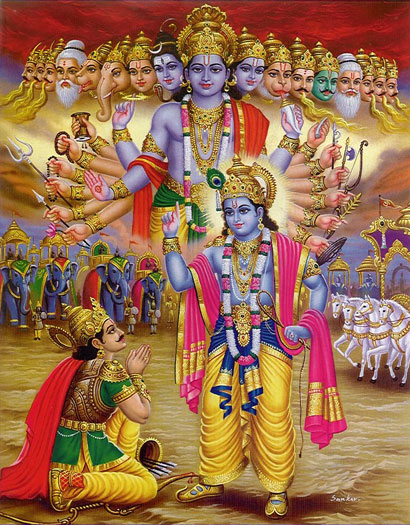
Here is some depictions of the Virata Rupa --- Universal Form of God.Thess are descriptions taken from the book the Bhagavad Gita-- the song of God.
TA-57.jpg
This is maha vishnu lying in the causal ocean with countless universes emanating from the pores of His skin.
The entire manifestation of universes is pushed out during the exhale, then the next cycle is called the inhale or pralaya when they all go back into Him and become reabsorbed.
2672_2132-mahavishnu.jpg
These are not fanciful creations of imaginations but are an attempt to crystalize images of the unfathomability of the workings of the universal space.
In order to see such a form as this Krishna -the all pervading cognizant- gave Arjuna divine eyes. Its was too awesome for Arjuna and he prays to please stop this I just want to see you as my friend.
vishswarupa.jpg
For the universal form is an impersonal feature of the truth and Arjuna preferred the personal aspect of Krishna GOD as a two armed being which he could relate to..
Read more…

You're Gonna Have to Serve Somebody

From Ashtara site; Responding to debate about the nature of Godhead

One thing for sure, our intellectualizations will not effect Godhead in one iota !  We are describing an approximation, what we ourselves currently understand to be God. That is alright, but is there a higher, closer approach possible? Considering that we are souls, and that the body is temporary and limited, then if we can breach these limits, then we can progress on to something true-er.

That is where meditation, prayer, chanting, devotionally-inspired  musics, performing austerities, and constant performance of devotional sevice come in. These are not intellectual processes per se, but heart based.

By hearing from the guru, saints, sastra (scripture) , thus giving up our egos built on the bastion of currently limited intelligence, we are given absolute revealed knowledge. Revealed knolwedge is not stagnant or rigid, but becomes rigidified as we bring it again down to within the realm of our speculative and processin

Read more…

CHAPTER 5

Fifth Shower of Nectar

When the devotee takes in his heart the golden medallion of bhakti, shining

effulgently by the fire of steady practice (nishtha) and propelled by its own energy,

ruci appears in that bhakti.

When a person develops a taste for the activities of bhakti such as hearing and

chanting, vastly greater than attraction for anything else, that is called ruci.

Unlike in the previous stages, at the stage of ruci, constant performance of

devotional activities like hearing and chanting does not result in even the least

fatigue.

Ruci quickly produces an intense addiction to the activities of bhakti. This is similar

to the brahmana boy who, after diligently studying the scriptures daily, in time

grasps the meaning, and then finds no difficulty at all in applying himself to study.

Moreover, he develops a pleasure in the performance his task.

The actual conclusion can be understood by the following example. Due to a defect in

the liver, the ability to taste becomes aff

Read more…

CHAPTER 4

Fourth Shower of Nectar

Previously, in the discussion of the two types of bhajana kriya, anishthita and

nishthita, six types of the anishthita bhajana kriya were described.

Without describing nishthita bhajana kriya, anartha nivritti was discussed.

Because it says in Srimad Bhagavatam:

srnvatam sva-kathah ksrnah

punya-sravana-kirtanah

hrdy antah stho hy abhadrani

vidhunoti suhrt satam

nasta-prayesv abhadresu

nityam bhagavata-sevaya

bhagavaty uttama-sloke

bhaktir bhavati naisthiki

Lord Krishna, who is affectionate to His devotees and situated in their hearts,

destroys all inauspicious elements of those who hear topics about the Lord. When

the inauspicious elements have been generally destroyed by devotional service, steady

devotion to the Lord appears. (SB:1.2.17-18)

The first verse (srnvatam sva-kathah...) refers to the stage of anishthita or unsteady

bhakti, for naistiki bhakti or nishthita bhakti makes its appearance later in the

second verse.

Abhadrani vidhunoti (destruc

Read more…

CHAPTER 3

Third Shower of Nectar

After bhajana kriya, comes anartha nivritti, or clearing of bad qualities which

obstruct the progress of bhakti.

Anarthas may be classified into four types, according to origin:

those arising from previous sinful activity

those arising from previous pious activity

those arising from offenses

those arising from bhakti

Anarthas arising from previous sinful activities fall in the category of the five types

of klesha previously mentioned:

ignorance, false ego, attachment, hatred and fear of death.

Anarthas arising from pious activities are the addictions to the enjoyments which

arise from pious action. Some sages include the anarthas arising from pious activities

under the categories of the kleshas mentioned above.

Anarthas which arise from offenses refers to those arising from the nama

aparadhas, not seva aparadhas (such as entering the temple in a palanquin or with

shoes).

The acharyas have discerned that seva aparadhas do not usually have effect being

Read more…

Thanks to Uttamsloka Prabhu for alerting us to these saastra.


CHAPTER 2

Second Shower of Nectar


In this work one will not find a full dissertation on dualism and monism but, for those

who expect it, they may find it in another work called Aishvarya Kadambini.

Pure bhakti, unmixed with karma and jnana, is like a wish-fulfilling creeper appearing

in the field of the senses. This bhakti is the refuge of those devotees who firmly

vow (dhrita vrata) never to seek any fruits except bhakti, like bees (madhu vrata)

who are obsessed with the desire to taste only nectar.

The very life of this creeper is a favorable attitude for service for the pleasure of

the Lord. Like a touchstone, the very presence of bhakti makes the heart and senses

gradually lose their iron-like material qualities and acquire pure golden spiritual

qualities.

As a sprouting creeper grows upwards and unfurls two leaves, in the process of

sadhana bhakti, two qualities make their appearance. The first is called kleshagh

Read more…