"When Arjuna wanted to become a nonviolent coward on the Battlefield of Kurukṣetra, he was severely chastised by Lord Kṛṣṇa. The Lord degraded Arjuna at that time to the status of an uncivilized man for his avowed acceptance of the cult of nonviolence. The administrative class must be personally trained in military education. Cowards should not be elevated to the presidential throne by dint of numerical votes only. The monarchs were all chivalrous personalities, and therefore monarchy should be maintained provided the monarch is regularly trained in the occupational duties of a king. In fighting, the king or the president should never return home without being hurt by the enemy. The so-called king of today never visits the warfield. He is very much expert in artificially encouraging the fighting strength in the hope of false national prestige. As soon as the administrative class is turned into a gang of mercantile and laborer men, the whole machinery of government becomes polluted. "
Th
All Posts (4110)
Sort by
Sri Srimad Bhaktivedanta Narayana Gosvami Maharaja
LALITA-DEVI'S APPEARANCE DAY
September 10, 2005

[This year, 2022, Srimati Lalita-devi’s appearance day is on Sept 2, one day before Radhastami. The following is a transcription of the class given in her glorification, and it explains her significance in our personal lives:]
Lalita-devi was born in the village of Karehla, and later on her father brought her to Uccagaon, the place of her pastimes (lila-sthali). There are still many evidences of her pastimes here, like a rock containing the imprints of her lotus feet and some small utensils she used when she and the other sakhis fed Krsna there. When the sun-rays fall on the imprints of those pots and plates, they glitter and shine. All of Srimati Radhika’s sakhis used to play with Krsna and Lalita in Uccagaon, and there are many places there where you can see their footprints to this day.
On the hill there is a slippery rock showing a specific pastime
Tamohara@1234gone
Mohini Murti Devi Dasi shared a link.
https://www.youtube.com/c/HearSrilaPrabhupada
Hear Srila Prabhupada - YouTube
http://YOUTUBE.COM
Hear Srila Prabhupada - YouTube
We are honored to present to you the complete collection of Srila Prabhuapda's audio recordings. Please hear always from His Divine Grace, and perfect the hu...
https://www.youtube.com/c/HearSrilaPrabhupada
Hear Srila Prabhupada - YouTube
http://YOUTUBE.COM
Hear Srila Prabhupada - YouTube
We are honored to present to you the complete collection of Srila Prabhuapda's audio recordings. Please hear always from His Divine Grace, and perfect the hu...

Hear Srila Prabhupada
We are honored to present to you the complete collection of Srila Prabhuapda's audio recordings. Please hear always from His Divine Grace, and perfect the human…
www.youtube.comView Link FeedThe following conversation between His Divine Grace A.C. Bhaktivedanta Swami Prabhupada and some of his disciples took place in 1973 on an early morning walk in San Francisco.
First disciple: Srila Prabhupada, recently a student committed suicide here. It’s happening all over the country.
Srila Prabhupada: Some are publicly committing suicide, and others are silently committing suicide. If the human life is wasted for sense gratification, that is suicide. People have the opportunity for enlightenment, yet they live like dogs and cats. This is suicide.
Second disciple: One month ago there was a big story in the papers about how a student went through the archives in the Library of Congress and compiled enough information to construct an atom bomb. They concluded that, theoretically, anyone who wanted to could gather enough information from public sources and build an atom bomb.
Srila Prabhupada: This is also suicide. The atom bomb manufacturer is thinking he is successful in his
VRNDAVANA BHAJANA
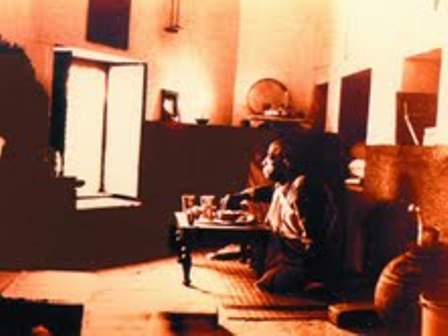
“Srila Prabhupada was poetic, not only in the literary sense, as evidenced by his beautiful poems glorifying his spiritual master and Lord Krsna, but in every aspect of his personality as well. His gesturing, walking, talking, singing, smiling, dancing andarcana were all performed with an extremely natural poetic grace, befitting a swanlike pure devotee of Lord Krsna. For those sensitive souls who had embarked upon a pilgrim’s progress in search of truth, beauty and ultimate happiness, association with Srila Prabhupada marked their journey’s end, and they happily gave up all mundane pursuits and engaged in his service. Such was the attractive force of Srila Prabhupada’s poetic nature, which manifested fully due to his superexcellent level of Krsna consciousness.” (from In Praise of Srila Prabhupada by Ajitananda das)
The following is a poem written by Srila Prabhupada entitled “Vrndavana Bhajana”
Srila Prabhupada’s statements about World War III

Thus a godless civilization becomes the source of all calamities
“Thus being advised by the demoniac ministers, Kamsa, who was from the very beginning the greatest rascal, decided to persecute the brahmanas and Vaisnavas, being entrapped by the shackles of all-devouring, eternal time. He ordered the demons to harass all kinds of saintly persons, and then he entered his house. The adherents of Kamsa were all influenced by the modes of passion as well as illusioned by the modes of ignorance, and their only business was to create enmity with saintly persons. Such activities can only reduce the duration of life. The demons accelerated the process and invited their deaths as soon as possible. The result of persecuting saintly persons is not only untimely death . The act is so offensive that the actor also gradually loses his beauty, his fame and his religious principles, and his promotion to higher planets is also checked. Driven by vari
Live Darshan | Online to ISKCON | ISKCON Vrindavan | Sri Sri Krishna Balaram Mandir
Do we as individuals love and serve Godhead Sri Krsna because He is All-powerful and can fulfill our needs, and protect and deliver us? Or do we love Him for Himself, the Person Krsna?
It is embarassing and even hurtful for one who is Krsna's friend to have to beg or worry about salvation and the power to do some actually useful and pleasing devotional service to Godhead. One wants to be independent, then as an equal, one can show that one appreciates Krsna the person for Who He is and what is His character, not merely like a business order supplier. One's family are at a different level of intimacy.
It is embarassing and even hurtful for one who is Krsna's friend to have to beg or worry about salvation and the power to do some actually useful and pleasing devotional service to Godhead. One wants to be independent, then as an equal, one can show that one appreciates Krsna the person for Who He is and what is His character, not merely like a business order supplier. One's family are at a different level of intimacy.

Sri Srimad Bhaktivedanta Narayana Gosvami Maharaja
Baladeva’s Birthday
[Baladeva Purnima]

[Respected Harikatha Readers,
This year, 2022, Lord Baladeva’s appearance day anniversary is August 11. Srila Gurudeva Bhaktivedanta Narayana Gosvami Maharaja gave a discourse in His glorification in Hindi, translated by Radhika dasi of Russia. The following is a transcription of that translation:]
Today is the appearance day of Rohini-nandana Baladeva. According to the Vedic scripture Garga-samhita, Baladeva Prabhu appeared after Janmastami, but if this is accepted, there would be confusion. Baladeva would be older than Krsna by one year, and then They would not be able to play together, wrestle on equal terms, and have Their name-giving ceremony performed for both of Them at the same time. Therefore, Srila Jiva Gosvami has explained, “Baladeva Prabhu appeared after Jhulana-yatra on the purnima, the full-moon day, and Sri Krsna appeared seven days later on bhadra-astami, the auspicious eighth day of
TOPIC: Go To Hell!!!!!!!!!!!!!!
Prabhupada: We are preaching Bhagavad-gita. If you like, you take it. Otherwise, go to hell. Who cares for you? We have started this institution, "Krsna Consciousness." So if you do not accept Bhagavad-gita, then why did you come here? Why do you come here? You go away. We are not hankering after you. If you go to hell, go. Go there. Who objects? Go. But if you come here, then you must be Krsna conscious. We, our Society, it is Krsna consciousness. So why do you come here for if you don't believe in Krsna? Go to hell. Don't come here. If you want to understand Krsna, then come here. That is the first principle. Therefore in New York somebody suggested that "Make this 'International Society of God Consciousness." That will be great havoc. They'll bring, rascals, so many Gods. Make it clear, "Krsna consciousness." If you are interested in Krsna, then come here. If you are interested in something else, you go there.>>> Ref. VedaBase => Morning Walk -- Ju
Paris June 15, 1974
How we can recognize a person truly free from the influence of material nature.
prayena munayo rajan
nivrtta vidhi-sedhatah
nairgunya-stha ramante sma
gunanukathane hareh
 >
>
"O King Pariksit, mainly the topmost transcendentalists who are above the regulative principles and restrictions take pleasure in describing the glories of the Lord." (Srimad-Bhagavatam 2.1.7)
There is a stage called the paramahamsa stage. At that time, one does not very strictly follow the regulative principles. Or, rather, it is not that the paramahamsas are not following, but they're above all regulative principles. We should not imitate that position: "Now we have become paramahamsas, and we can neglect all regulative principles." No. You must prove that you are a paramahamsa.
What is the paramahamsa stage? Na
The whole material world is but God.
For God, Sri Govinda, everything is the spiritual world. Our lack of spiritual vision is the material situation. When we reawaken, we are also with Him in the spiritual world, everywhere we go.
for example;
The grass, reaches for the sun warmth and light, reaching for God in it's small manifestation, as food and light. The parked cars, they are manifestations of God's tendency to freedom, comfort, fun, colorful creation, intelligence, protection, power, mobility, communications and useful service done. These are His qualities, reflected in a small and temporary way via the souls as humans; a car.
The air, nourishes us, like the Mother. The sky is open and invitingly mysterious. In this way, the original source, sarva karana karanam, Sri Krsna, is reflected in infinite smaller manifestations, everything is a partial manifestation of attractive qualities of Godhead.
Everywhere we receive mercies and sustenance and beauty, and the will to
The science of God-consciousness is very complex and deep, like a reach up for the stars or down into the Marianna Trench. One could do doctorates in it for many kalpas of yugas of lifetimes.
But the simple innocent protective love of a Mother for her little child is the distilled and pure emotional peak of love, and when applied to God, this is the highest perfection of our Being, as He made us. When He is like our heart-breakingly dear Little One to us, to be cared for and to see His sweetly smiling small Face, then we know eternal love which grows and never ends, with actual full exchange to our heart's satisfaction and amazement.
No big brain required, no degrees. a child or an old old woman can easily find love of God in Deity worship, as opposed to study, meditation, huge sacrifice, or severe austerity. It is our natural tendency to love, applied to God, that is all. It grows almost automatically, like a flower from a fertile seed, given daily watering and sunlight
But the simple innocent protective love of a Mother for her little child is the distilled and pure emotional peak of love, and when applied to God, this is the highest perfection of our Being, as He made us. When He is like our heart-breakingly dear Little One to us, to be cared for and to see His sweetly smiling small Face, then we know eternal love which grows and never ends, with actual full exchange to our heart's satisfaction and amazement.
No big brain required, no degrees. a child or an old old woman can easily find love of God in Deity worship, as opposed to study, meditation, huge sacrifice, or severe austerity. It is our natural tendency to love, applied to God, that is all. It grows almost automatically, like a flower from a fertile seed, given daily watering and sunlight
Sri Sri Radha Govinda are the essence of youthful early-maturity and enthusiasm in the pursuit of love. A freshness of innocence, yet perfection of sensual beauty, is held by the Divine Couple.
When we think of a very young human couple, whom we care about, married or together young, we are filled with happiness at their joy and youthful love. We wish to protect and nurture, to feed them, to perhaps play them a tune, to encourage and laugh and enjoy their pastimes, with our wisened aspect on life's tides.
Similarly devotees of God in the Eternal Youthful Form of Sri Govinda relish similar moods, but because Godhead is eternal, these relationships simply grow and become sweeter, rather than diminish and die within mundane time among mundane temporal beings. One is encouraged to learn to relish such simply charming sweetness of Being.
When we think of a very young human couple, whom we care about, married or together young, we are filled with happiness at their joy and youthful love. We wish to protect and nurture, to feed them, to perhaps play them a tune, to encourage and laugh and enjoy their pastimes, with our wisened aspect on life's tides.
Similarly devotees of God in the Eternal Youthful Form of Sri Govinda relish similar moods, but because Godhead is eternal, these relationships simply grow and become sweeter, rather than diminish and die within mundane time among mundane temporal beings. One is encouraged to learn to relish such simply charming sweetness of Being.

|
||||||||
|

Spirit Eh Tom@Liberated2
Just as there is great sacrifice and hence spiritual merit, in spreading the chanting of the holy Names, yet there is also great bad karma if one spreads a false or deviant cult. If one knows a sin is going on nearby and one can do something, and does not, then one is also eligible for the karma of the sins. That good or bad karma is multiplied many times as the Movement and/or false cult expand, and one's credit or culpability.
So, my Godbrothers in Iskcon who have failed to oust the poisoners and the globalist jewish take-over cult, and may even be part of the kill guru become guru agendas, are culpable, whereas I and those I have been honored to have helped with providing authorized initiation, have resisted the cults., so, we all get the good results, and none of the bad. Just saying.
ps there are very few bonafide disciples of Srila Prabhupada in the current ISKCON ,as it is known to the public, by dint of their stolen a
So, my Godbrothers in Iskcon who have failed to oust the poisoners and the globalist jewish take-over cult, and may even be part of the kill guru become guru agendas, are culpable, whereas I and those I have been honored to have helped with providing authorized initiation, have resisted the cults., so, we all get the good results, and none of the bad. Just saying.
ps there are very few bonafide disciples of Srila Prabhupada in the current ISKCON ,as it is known to the public, by dint of their stolen a
Room Conversation
- Type:
- Room Conversation
- Date:
- April 22
- Year:
- 1972
- Place:
- Tokyo
Prabhupāda: harer nāma harer nāma harer nāma eva kevalam [Cc. Ādi 17.21]
What is that, that… [indistinct] the Deities?
Devotee: Oh, the Deities?
Prabhupāda:
śrī-vigrahārādhana-nitya-nānā-
śṛṅgāra-tan-mandira-mārjanādau
[Śrī Śrī Gurv-aṣṭaka 3]
Wherefrom we got this?
Sudāmā: Tamāla Kṛṣṇa sent these from Los Angeles three years ago.
Cintāmaṇi: They stayed in the closet.
Prabhupāda: So who will paint?
Sudāmā: Cintāmaṇi will paint.
Prabhupāda: So take note. So eyes are all right. Eyes are all right. It is all right. Simply you have to…, all the hairs to make black up to the… It is all right?
Cintāmaṇi: Yes.
Prabhupāda: Then His hands should be red.
Cintāmaṇi: What about this? She’s holding?
Prabhupāda: She holds the sārī, skirt. She holds some cloth.
Sudāmā: Some cloth.
Prabhupāda: Like this.
Cintāmaṇi: Oh.
Prabhupāda: This is the… Do it. And this hand is betel nut.
Cintāmaṇi: Bete

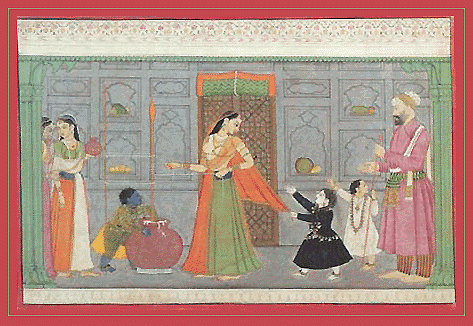
Parjanya Maharaja (paternal grandfather)
Krsna's fair-complexion, white-haired and white-attired grandfather is named Parjanya Maharaja, because he is like a great cloud (parjanya) showering the nectar of auspiciousness. He is the best of all the residents of Vraja.
Desiring a worthy descendant, he followed the advice of Devarsi Narada and engaged in the worship of Lord Narayana, the husband of Laksmi. As he was worshiping Narayana at Nandisvara-pura, a pleasant voice spoke the following words from the sky:
"Because of your pious austerities you will obtain five sons. Of these sons the middle one, named Nanda, will be the best. Nanda's glorious son will delight the residents of Vraja. He will defeat all oppositions. Both the demigods and demons will worship Him, touching the jewels of their crowns to His lotus feet."
Hearing this, Parjanya Maharaja became happy and decided to reside at the place. He lived there until he saw the Kesi demon arri
Sri Srimad Bhaktivedanta Narayana Gosvami Maharaja
|

